Living in Saint Louis in 2026, we are faced with the unenviable task of trying to right a century of wrongs when it comes to race, culture, and strategic disinvestment. It feels like every week we are forced to confront the legacies of segregation, redlining, blockbusting, white flight, and an inequitable access to economic resources that is both systemic and multigenerational.
Our most recent incarnation of this tangled skein of problems (for now) is Club Imperial, located at 6306-6328 W Florissant Avenue in Walnut Park West.
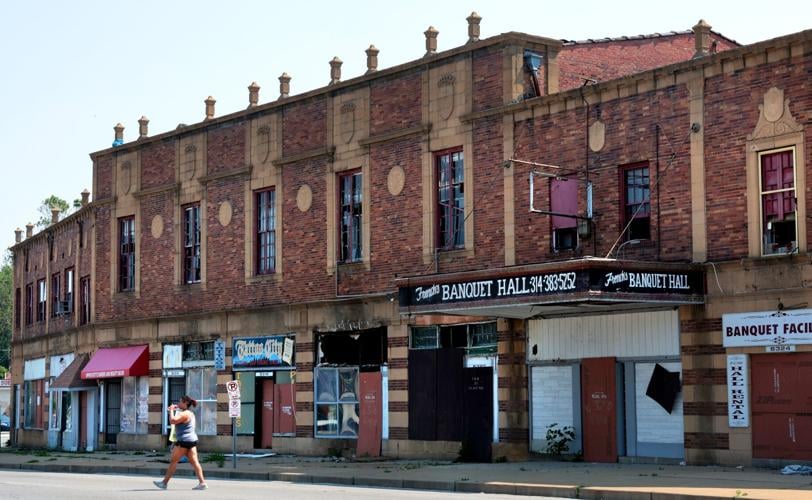
A group of buildings that once housed Club Imperial, a nightclub where Tina and Ike Turner performed in the 1950s and ’60s, is seen Wednesday, May 24, 2023, in the 6300 block of West Florissant Avenue. Photo by Robert Cohen, Post-Dispatch
Not just the home base for world-famous musical acts like Ike and Tina Turner and Chuck Berry, and allegedly the place where a young Jimi Hendrix met Miles Davis, Club Imperial represented a new era of integrated American music. George Edick, the white owner of a swing and jazz nightclub in an all-white neighborhood booked cutting-edge black musicians for standing weekly gigs, exposing suburban white audiences to early rock and R&B.
George Edick faced significant pressure from neighbors in North Saint Louis in the 50s and 60s for having black employees and bringing in black musicians. Still, the draw of the music was immense and white teenagers from all over Saint Louis would pack the club to see Bob Kuban and the In-Men, Johnny Rabbit, and Ike Turner and the Kings of Rhythm (which would evolve into the Ike and Tina Turner Revue). George eventually financed a live television program called Party Time that further catapulted the Saint Louis R&B scene to prominence, and in the 60s Club Imperial opened a basement venue for teenagers where some of the earliest counterculture bands performed. Club Imperial was an important cultural fixture in Saint Louis for twenty years.
The mainstreaming of artists like Ike, Tina Turner, and Chuck Berry laid the cornerstone for rock and roll, disco, and rap. In fact, virtually all modern pop music has artists that performed at Club Imperial in its DNA. Club Imperial is a truly important piece of American musical history.
Being one of the main destinations of the Great Migration and one of the nation’s largest cities in the late 19th and early 20th centuries, Saint Louis has long held an important place in American culture, where black musicians and entertainers could find an audience and rise to national prominence. And in 2026, what do we have to show for it?
Processes like de-industrialization, white-flight, disinvestment in public transit in favor of suburban car culture, misguided urban planning policies like slum clearance, and civic neglect have pushed us to a point where we have precious few cultural sites left for the pioneering black musicians who influenced all of modern pop music. With the clearance of the riverfront and Mill Creek Valley, we already lost countless sites of black cultural history in Saint Louis. The Castle Ballroom collapsed in 2012, the VA demolished the Palladium in 2022, and the Chuck Berry House, though listed on the National Register of Historic Places, is vacant and falling into disrepair.
And now we are faced with the demolition of Club Imperial. There is no easily-identifiable bad guy here. The SLDC is currently applying for the demolition permit, but are merely left holding the bag after years of abandonment, deferred maintenance by the previous building owners, and decades of economic decline spurred on by de-industrialization and disinvestment.
While we understand the difficult position SLDC is in regarding Club Imperial, we still oppose the demolition. Even though Club Imperial is in terrible shape and the real estate market in much of North Saint Louis is essentially broken – in that there is no feasible way to redevelop a building of this size without significant tax incentives and subsidies – we believe the story of Club Imperial is important not just to citizens of Saint Louis but to music fans around the world.
Our built environment reflects our cultural values. What does it say about us as a society if we allow cultural sites to fall prey to demolition via neglect? We don’t need another hero, but we do need time, and we need developers, architects, and lenders with the vision to help us see beyond Thunderdome.