By Julius K. Hunter
A personal reflection by Julius Hunter on the St. Louis Public Schools that shaped his life, career, and connection to the city.
Table of Contents
Part I
1Before I ever entered a newsroom television studio, I entered St. Louis public schools. Looking back, I realize those buildings shaped my life every bit as much as the teachers inside them. ey in uenced how I learned, how I taught, how I viewed my community, and ultimately who I became.
“We shape our buildings, and afterwards our buildings shape us.”
Sir Winston Churchill, October 28, 1943
The fact that this Churchillian piece of wisdom was proclaimed exactly two weeks before my birth most certainly has absolutely nothing to do with anything. Churchill could not have known that those words would perfectly describe my own story. Four St. Louis public school buildings, designed by three remarkable architects, quietly shaped the course of my life and, I suspect, the lives of thousands of others who walked through their doors.
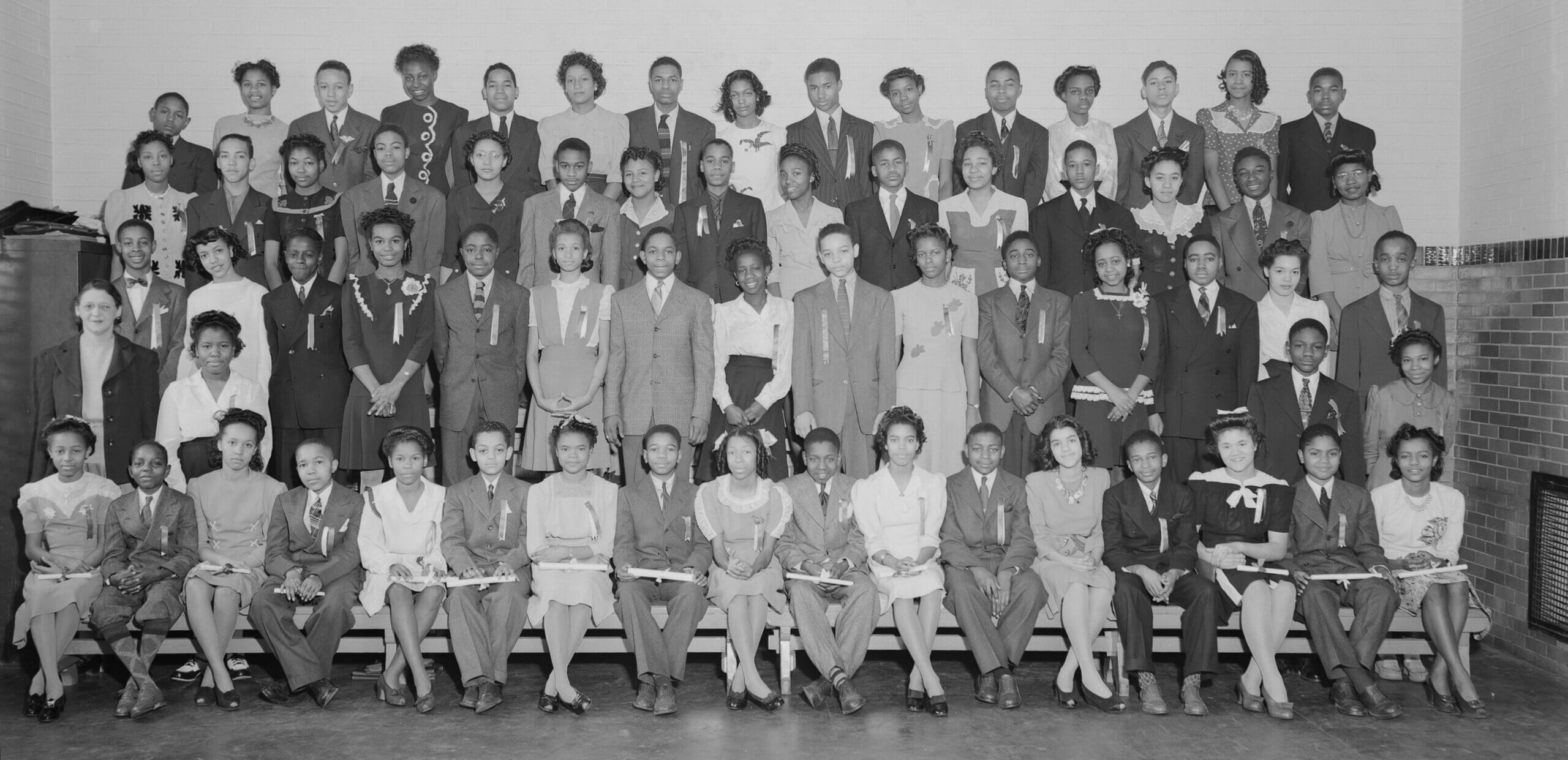
Cole Elementary School Graduates – January 1943, by unknown, 1943, negative. Missouri Historical Society, P0900-22608-01-8a.
This photo was taken the year that Churchill made his statement and is the year of Julius Hunter’s birth.
First Lessons: Cole Elementary School
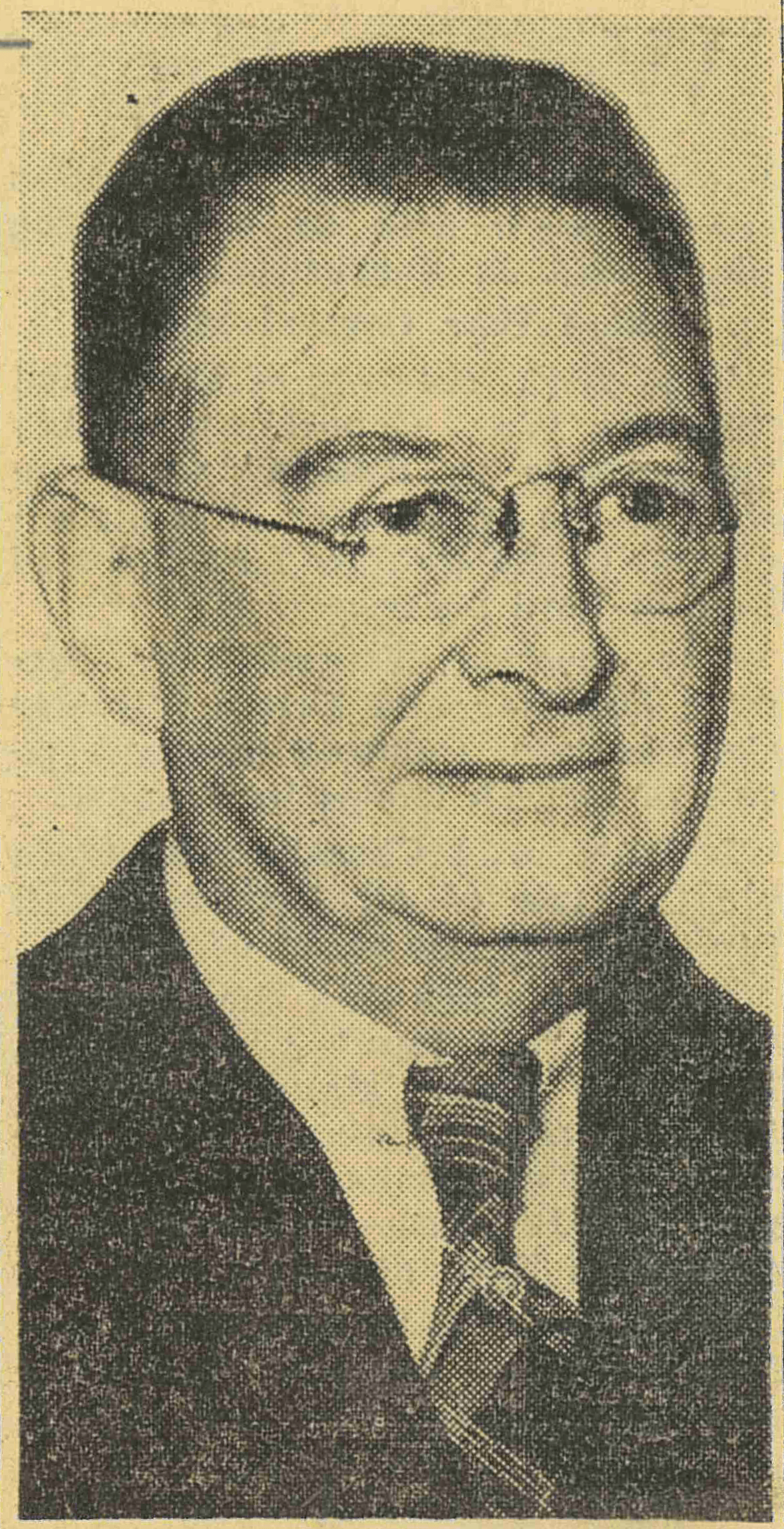
George W. Sanger
St. Louis Post-Dispatch, 9/13/1939
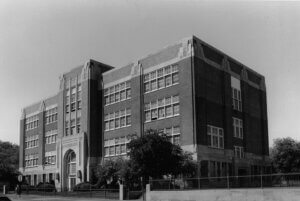
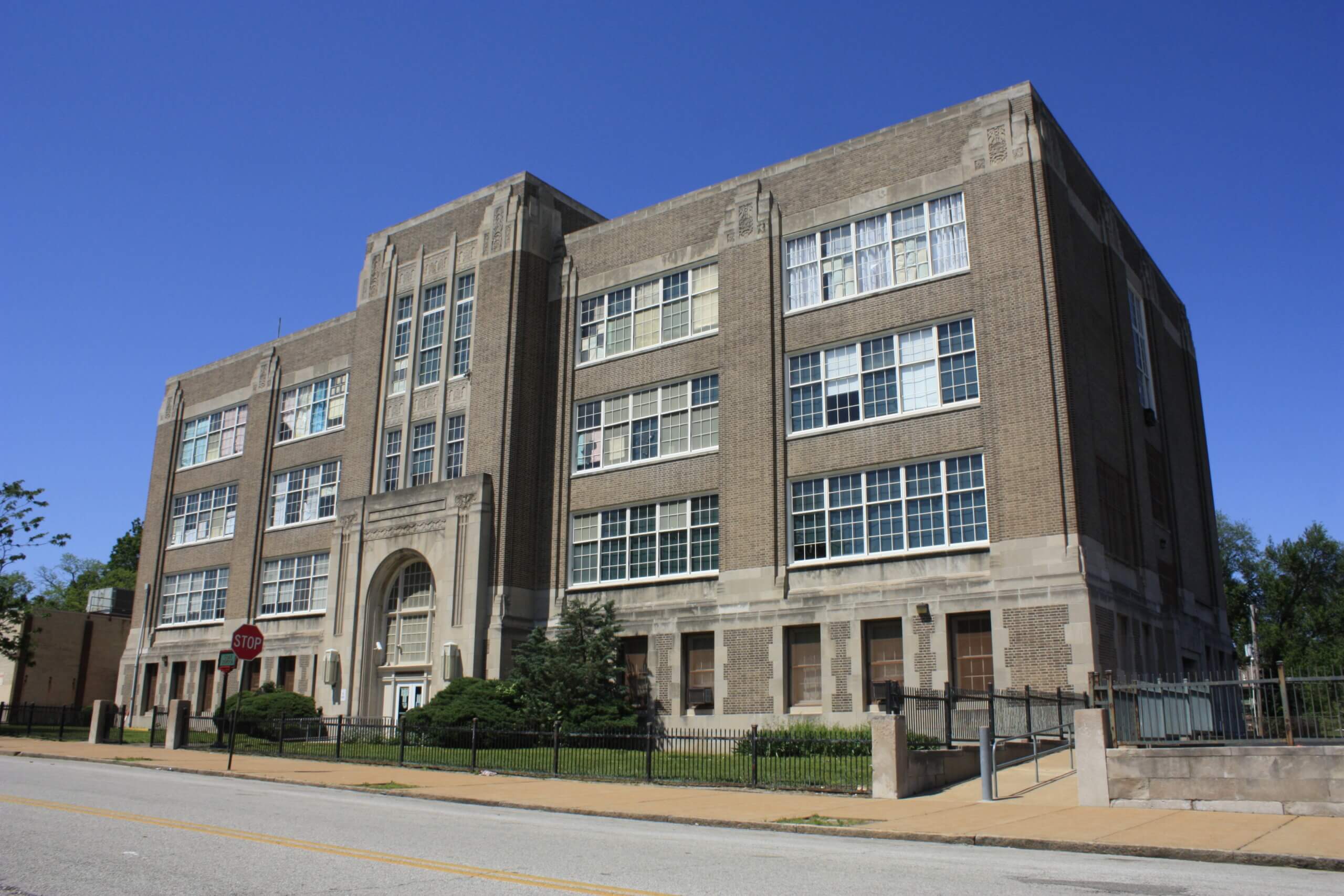
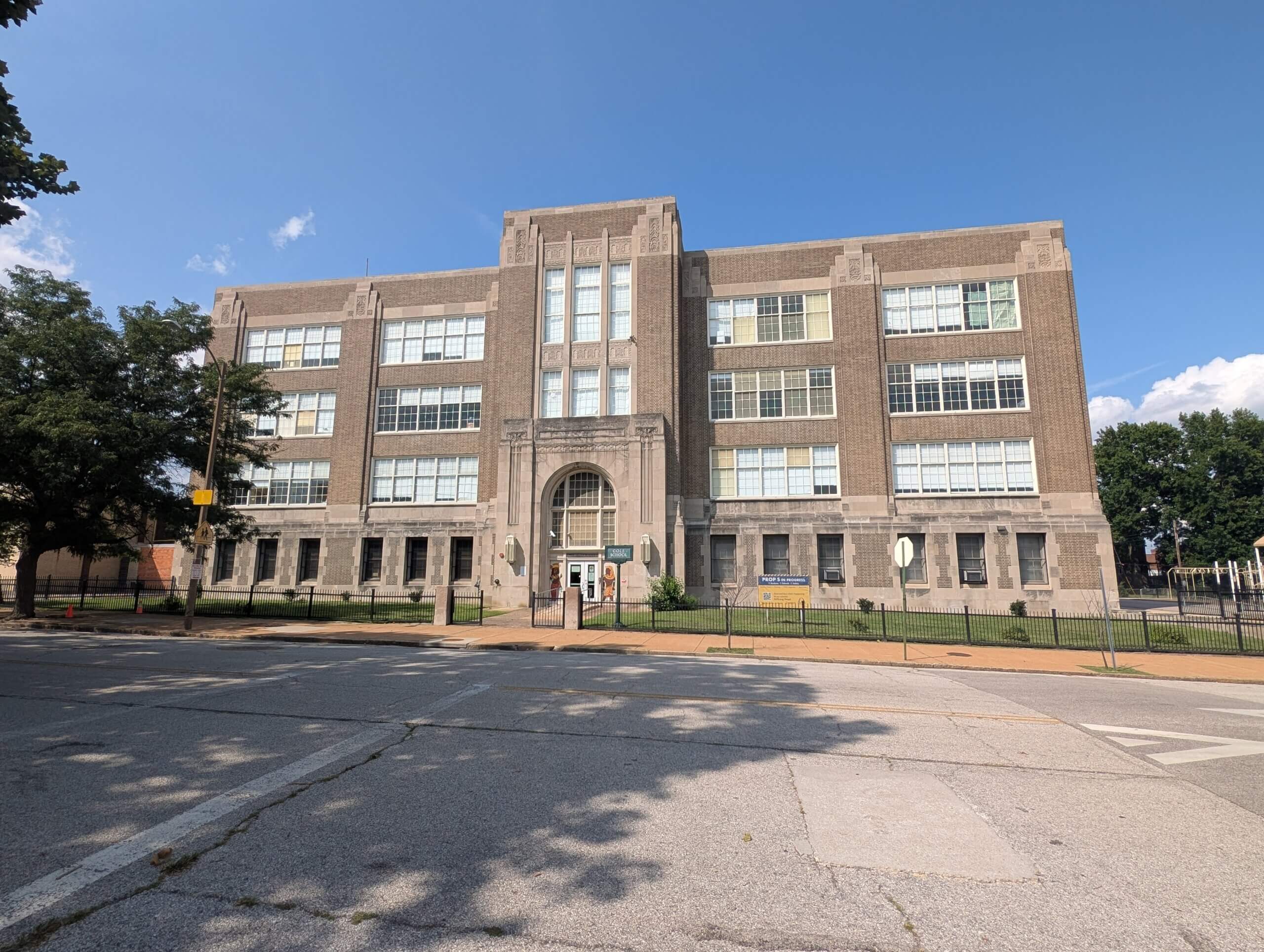
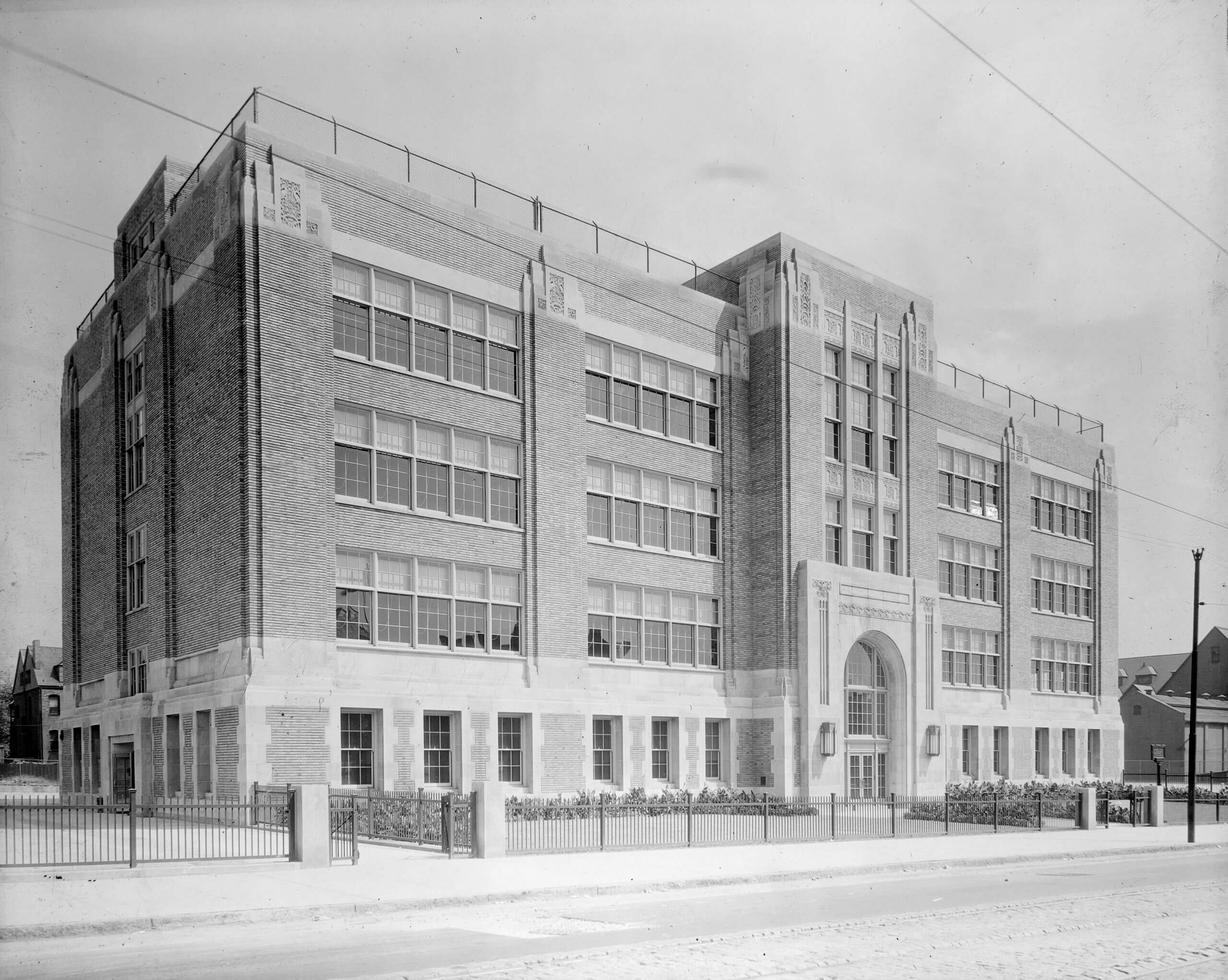
The first school building that began shaping my life as an impressionable student was the Richard H. Cole Elementary School. It’s located on the north side of Enright Avenue just a quarter block west of Vandeventer. Thee school’s design emerged from the drawing board of George W. Sanger immediately following the devastating Tornado of 1927. 2 3
Sanger’s draft notes called for “vertical emphasis placed on what is a very simple building by the use of stepped brick pilasters topped by stepped stone caps ornamented with a stylized floral design.”
Cost of construction in 1930: $337,167. Certainly nothing to sneeze at. In today’s dollars that would come out to about $6,647,000.
When it was time for me to enter Cole Elementary school in 1950, I could read circles around the other little kindergarten guys and dolls. Hallelujah! An ingenious older brother, Van, had taught me to read voraciously at home.
We had no books in our tiny “shotgun” apartment upstairs over a storefront barbershop on Vandeventer between Enright and Delmar. (It’s now the site of the Cardinal Glennon High School track and field.) But Van — recently graduated from Cole Elementary School himself and headed for injury in the Korean Conflict — was hellbent on a daring experiment! This teenage, undecorated genius was super-confident that he could prep me to blow right past the dark caves in which the grim Brothers Grimm lurked. Plus, Van, without ever being able to express it, saw no need for me to share in the storybook tragedies happening to children like “falling out of a treetop in a cradle;” or possibly getting a concussion after falling down a hill in search of water; or being stalked by a wolf.
The “Van Plan” was a homemade version of “Hooked on Phonics” long before phonics was hooked onto classroom curricula.
In his pre-school, non-Board certified, free-range lesson plans, Big Brother Van recognized the allure of learning names from the then thick Southwestern Bell telephone book. And then, how about all that beautiful reading material printed on grocery products? Have you ever thought about how much of a story there is on a soup can for the preschooler in your life? A box of Quaker Oats? A bottle — yes BOTTLE (now carton) — of milk? Eventually, the pages of the Post-Dispatch and Globe-Democrat were child’s play for me before I ever got to kindergarten.
So, perhaps to make their jobs less complicated, Cole School kindergarten teachers — Miss Lauric, and Miss Hayes (about the same height as we kindergarteners) — convinced stern Principal Creamus Evans to make me an Instant First-grader. What might not have happened in my gallivanting life had I been forced to dally a year in kindergarten?
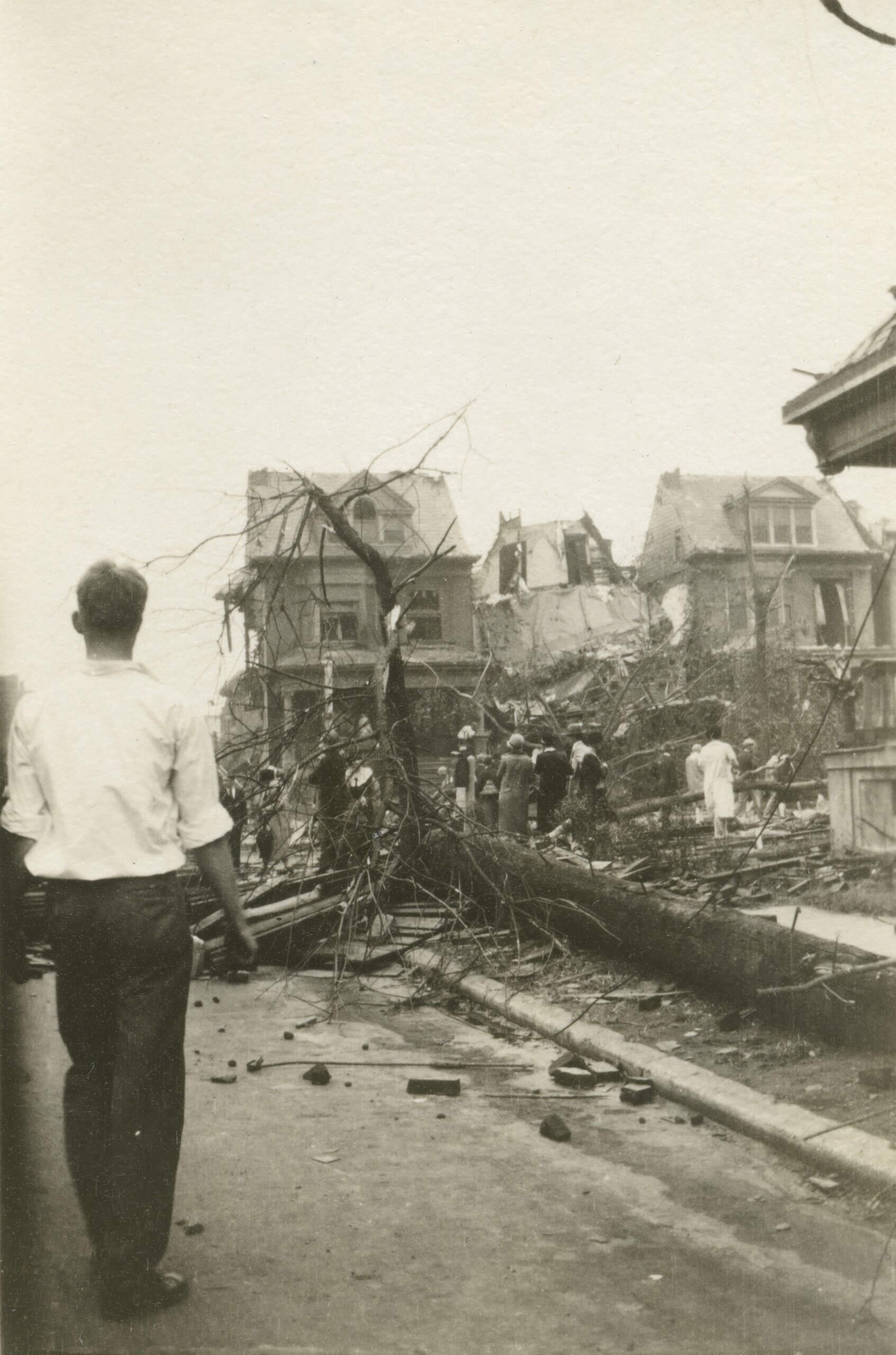
Tornado Damage to 4201 Westminster, by unknown, 1927, photograph.
Missouri Historical Society, P0981-0000
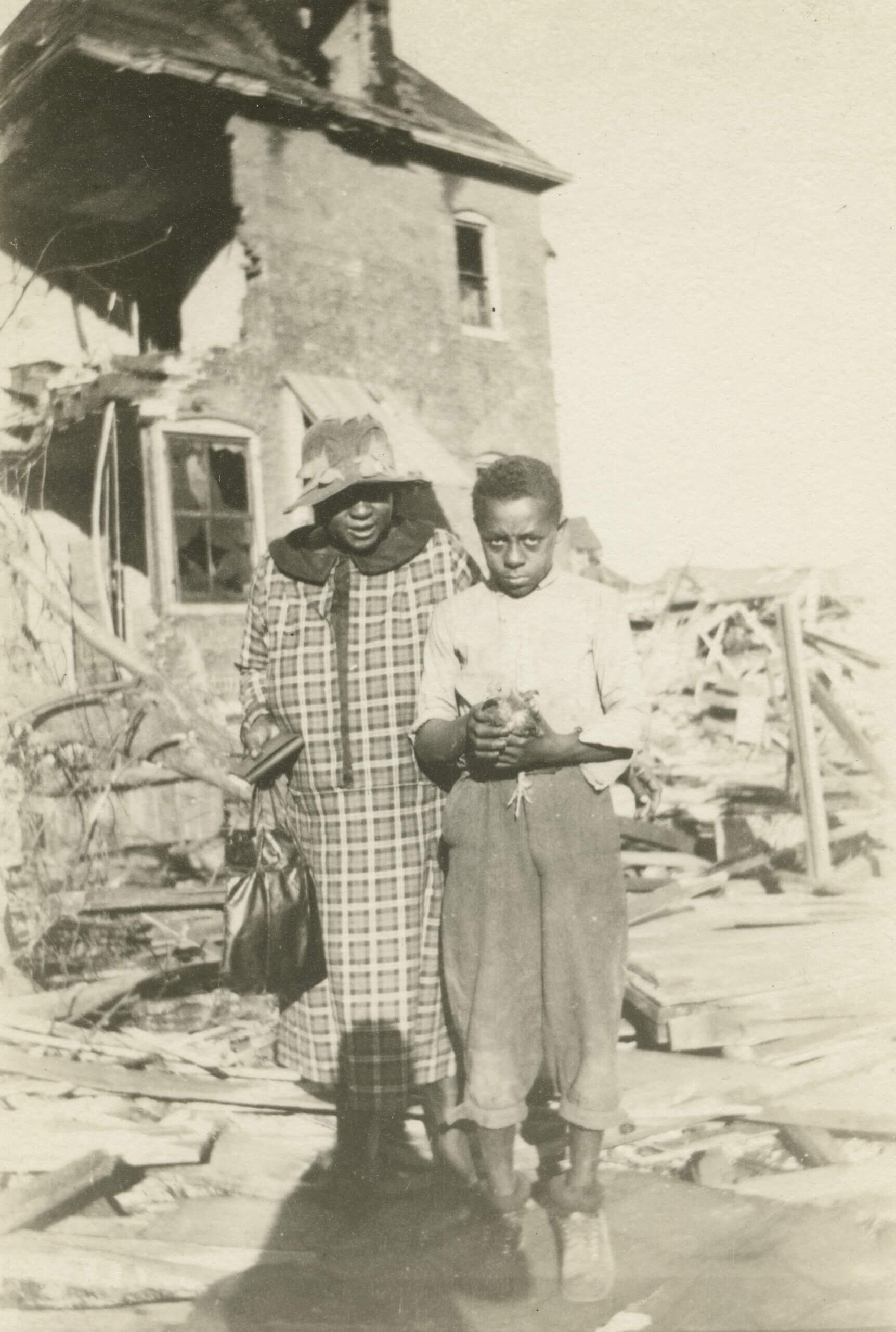
Woman and Boy in front of Tornado Damaged Home (West Bell), by unknown, 1927, photograph.
Missouri Historical Society, P0981-00005
One of the first things my classmates and I learned at Cole School was discipline!! Mr. Evans allowed absolutely ZERO talking after the school bell ordered us kids to either enter or vacate the building several times a day. ABSOLUTELY NO TALKING!!! That rule produced a certain reverence for the grey stone box that was Cole School. The “No Talking Rule” was underscored with each passage through the hallways. There was such an absence of sound in Cole’s hallways that we kiddos learned respect for a near-forgotten concept: silence. When we formally traversed the hallways in silence, Principal Evans planted himself in his first-floor, center-hallway chair. His pose was always Rodinesque. Was our silence out of respect for him? Or for the Cole School building itself? For the rare absence of sound? All the above, I’d say. Shhhh.
And speaking of reverence: When our parents were summoned to visit the building to answer for something we kids had done — or undone … our elders always got dressed in their “Sunday-go-to-church” best togs. Out of respect for parental responsibility? Reverence for Principal and teachers? Or respect for the building? I’d pick a three-way tie.
“Sanger shaped a building…and a building shaped a community. A mighty (little) fortress was our Cole!”
Teachers and Mr. Evans, and, thus, our parents, spoke to each other in quiet tones inside the Cole School walls. It always appeared there was a slight echo bouncing off marble. In the conference room the final score always seemed to be: “Big Folks”-1/”Littler Folks”-0. Was that outcome intentional when the architect designed Cole School?
Cole Elementary School – just 17-years older than I- remained a colorless — but impressionable — big grey box to my young eyes for a lot of years. Architectural Historian Chris Naffziger notes: That “by the 1930’s, the St. Louis School Board had turned away from the more traditional school building styles promoted by Ittner and Milligan — such as Tudor Revival — and adopted the Art Deco influences.” Nothing wimpish about Art Deco.
Oh, and did I mention in the list of functions — unintended by any architect — was that the Cole School playground was a favorite gathering place for the entire family and neighborhood on sweltering hot summer evenings? The internationally heralded Tom Powell VFW Marching Drum and Bugle Corps practiced on Cole School ‘s big playground lot. (The group was named after a Black U.S. Army “Messenger” killed in WWI France in 1918.)
During the summer month, in particular, when clocks struck anytime around six, entire families would drag out the blankets, picnic baskets, lemonade, adult beverages, and homemade barbecue grills for a marching band’s after-school treat. In fact, if you knew Sousa like we knew Sousa! The Police Department actually heralded the marching band’s rehearsal hours on the Cole School property as a major deterrent to general crime in our poor, but proud Cole School neighborhood! Everybody marched — even in place — to the pounding of drums, crashing of cymbals, brashness of bugles and piercings of piccolos on summer evenings!!
It may have been all illusion in retrospect, but it sure seemed like the big gray school box that bore the name, Cole Elementary, commanded a wave, a bow, a genuflect, a salute, a smile from everybody passing by the quietly imposing building from any direction. Any time of day or night. I also remember that regular pedestrian passersby — including my family and I — would always take a minute or two to pick up any truant trash blown or tossed irreverently onto the school’s tiny lawn. And then that refuse would be deposited in a nearby trashcan. Cole School lawn care was a second-nature thing for Cole School’s neighbors to do. Sanger shaped a building… and a building shaped a community. A mighty (little) fortress was our Cole!
Pride and Place: Sumner High School
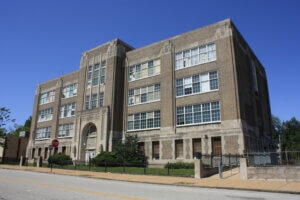
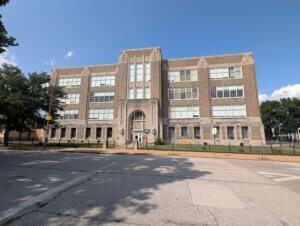
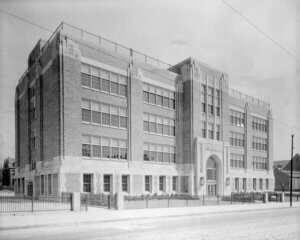
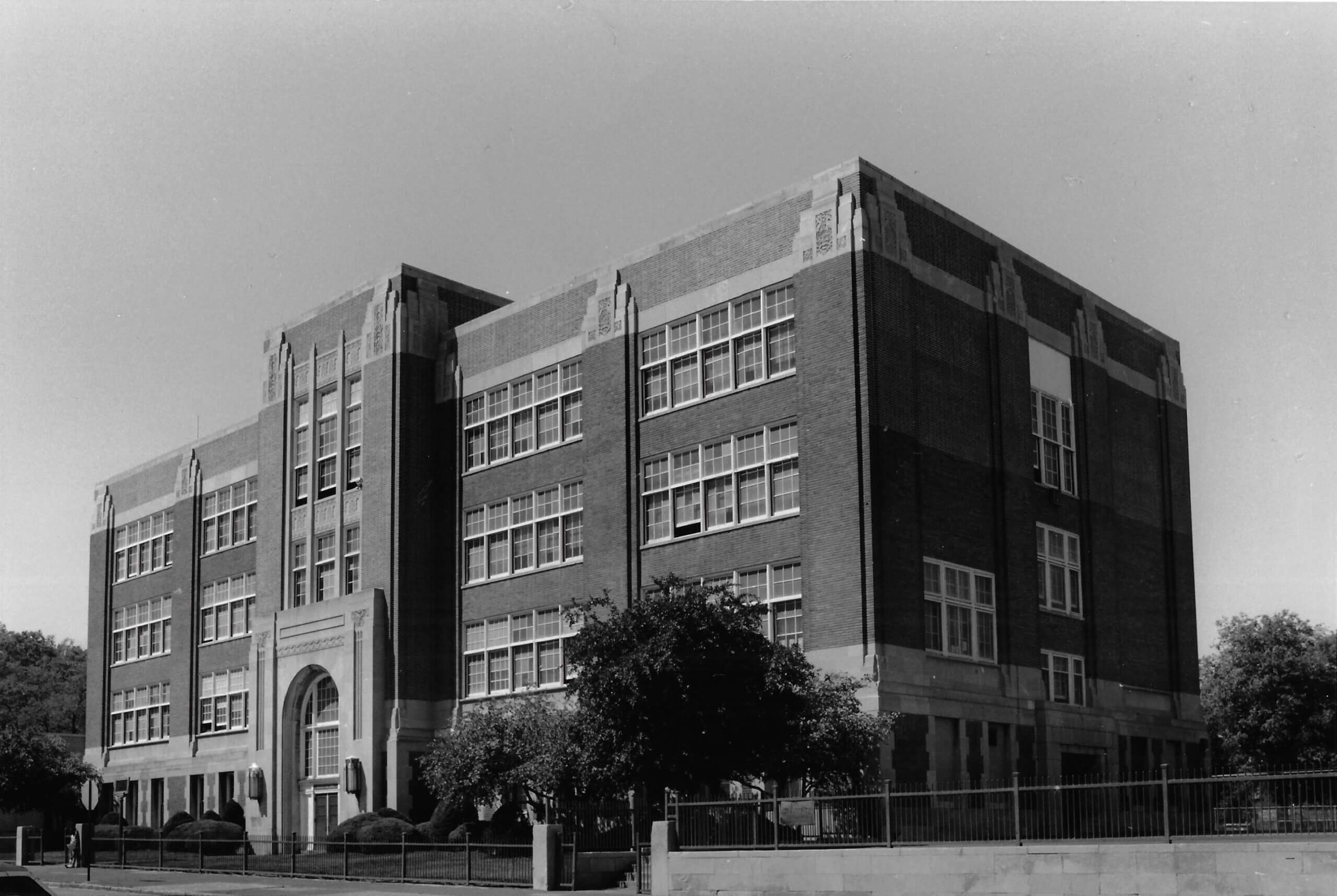
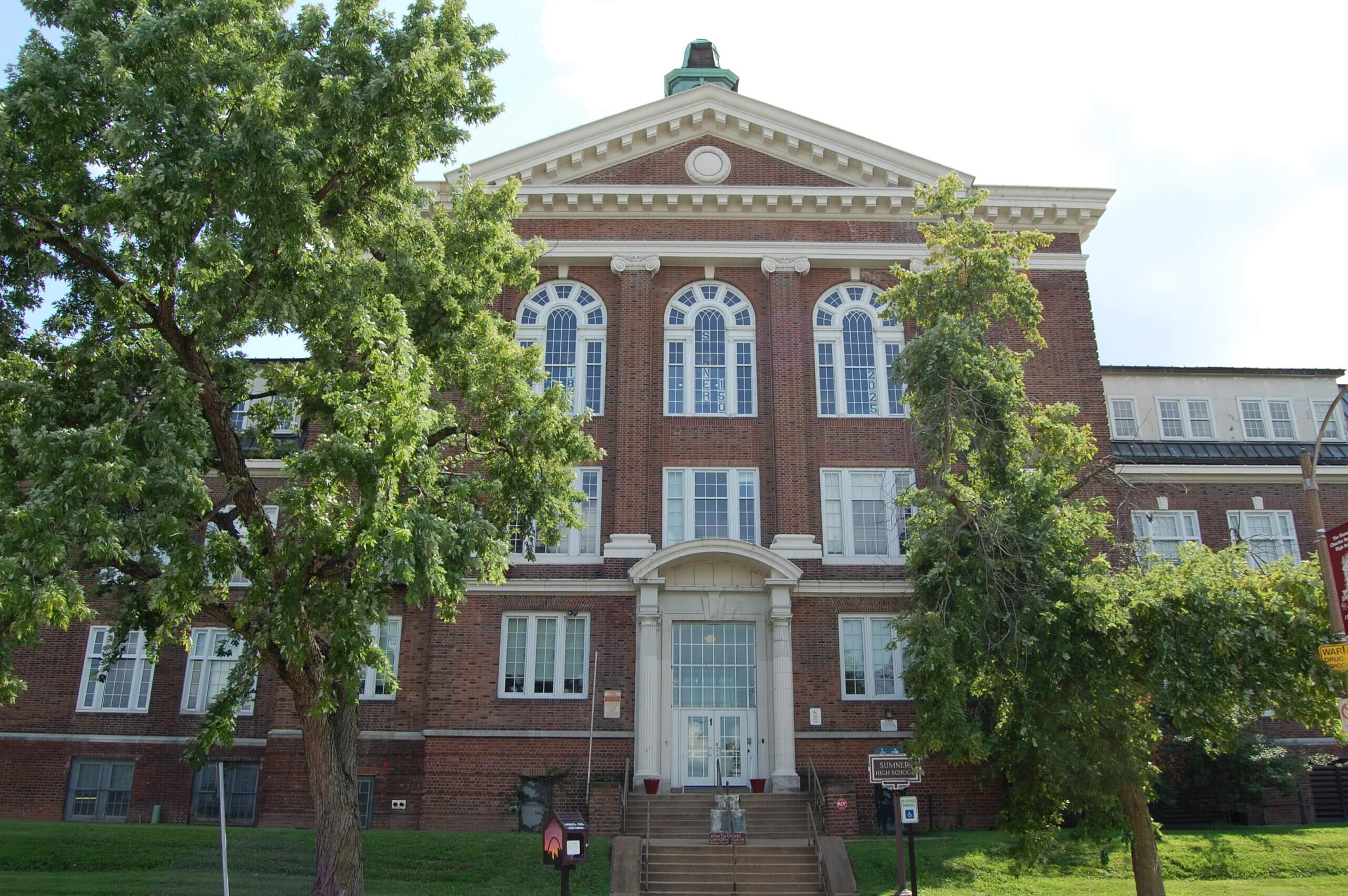
After 8th Grade at Cole, it was off to the vaunted Sumner High School in the already historic “Ville” neighborhood. I registered as a Freshman in January 1957 at the oldest high school specifically dedicated to African Americans west of the Mississippi! And my classmates and I were privileged to enter a campus crafted by St. Louis’ undisputed champion of school architecture. William Butts Ittner became the St. Louis School Board’s first ever Commissioner of School Buildings in St. Louis history.4 He took the job in 1897. And following petitions, after threats, after pleas, after entreaties, the STL School Board finally bowed to the community pressures and purchased a big hunk of property on Cottage Avenue in the “Ville”. For the first time in its history, Sumner High was not getting a hand-me-down school. And Ittner was allowed to go to bat and then go to town on the first decent — and ONLY “high school for colored” in St. Louis. In fact, the first high school specifically for Blacks west of the Mississippi!!! Named after a distinguished White abolitionist Senator, Charles Sumner. He was almost caned to death on the floor of Congress on May 22, 1856, by a slaveowner enraged by Senator Sumner’s anti-slavery rhetoric. Just a few months more than 170 years ago.
Ittner splurged as he crafted Sumner High School on 5-1/2 acres — including a track and field, tennis court and a football field directly across the street from Sumner’s front door.
“Ittner splurged as he crafted Sumner High School on 5-1/2 acres – including a track and field, tennis court and football field”
Disgracefully, Sumner High in St. Louis had debuted in 1875 in a hand-me-down dump of a building at 11th & Spruce. Then, ten years later, the school was relocated to a dilapidated worn warehouse of a building at 15th and Market. In 1906, when “THE Fair” was still in the air, a group of concerned Black citizens dared to petition the School Board for a brand new “high school for colored.”
Permission granted!
Ittner must have hastily filed away all his World’s Fair renderings to start working mightily on the sketches for this new Sumner High School. While he worked, Black students walking to and from classes each day were being subjected to a cacophony of catcalls from cathouses… and slimy slurs from saloons. What’s more — actually what was less — was the fact that Sumner students and staff had to twice daily walk past the City Jail gallows where public hangings — easily seen from the sidewalk — took place until 1930! — long after Sumner students, teachers and staff had been rescued.
Acting with all deliberate speed, Ittner’s Charles “Sumner High School for Colored” regally opened its doors for the first time in 1908. Chris Naffziger describes the then $1.8 million high school that made eyes… and then buttons pop:5
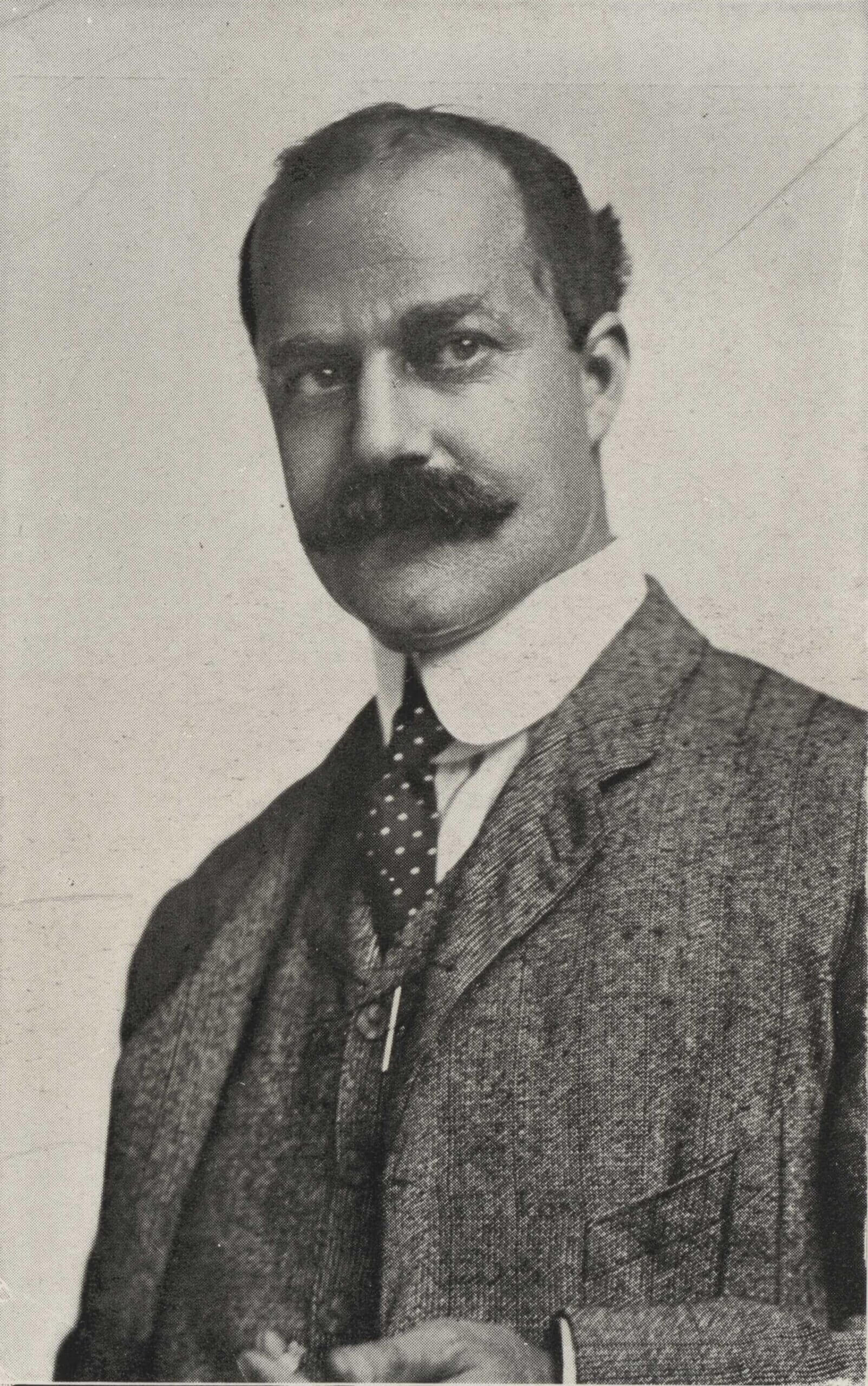
Portrait photograph of William B. Ittner (from The Makers of St. Louis, 1906).
Missouri Historical Society.
For the then new Sumner High School, Ittner turned to a style he had not yet visited for a high school: the “Georgian Revival,” Chris notes. “Rejecting the Collegiate Gothic of many of his other compositions. Sumner featured classical influences such as Palladian windows and cupolas high above a strict symmetrical composition. Rejecting complex decoration, the brick and windows are simple, but elegant, reflecting a more classic edifice.
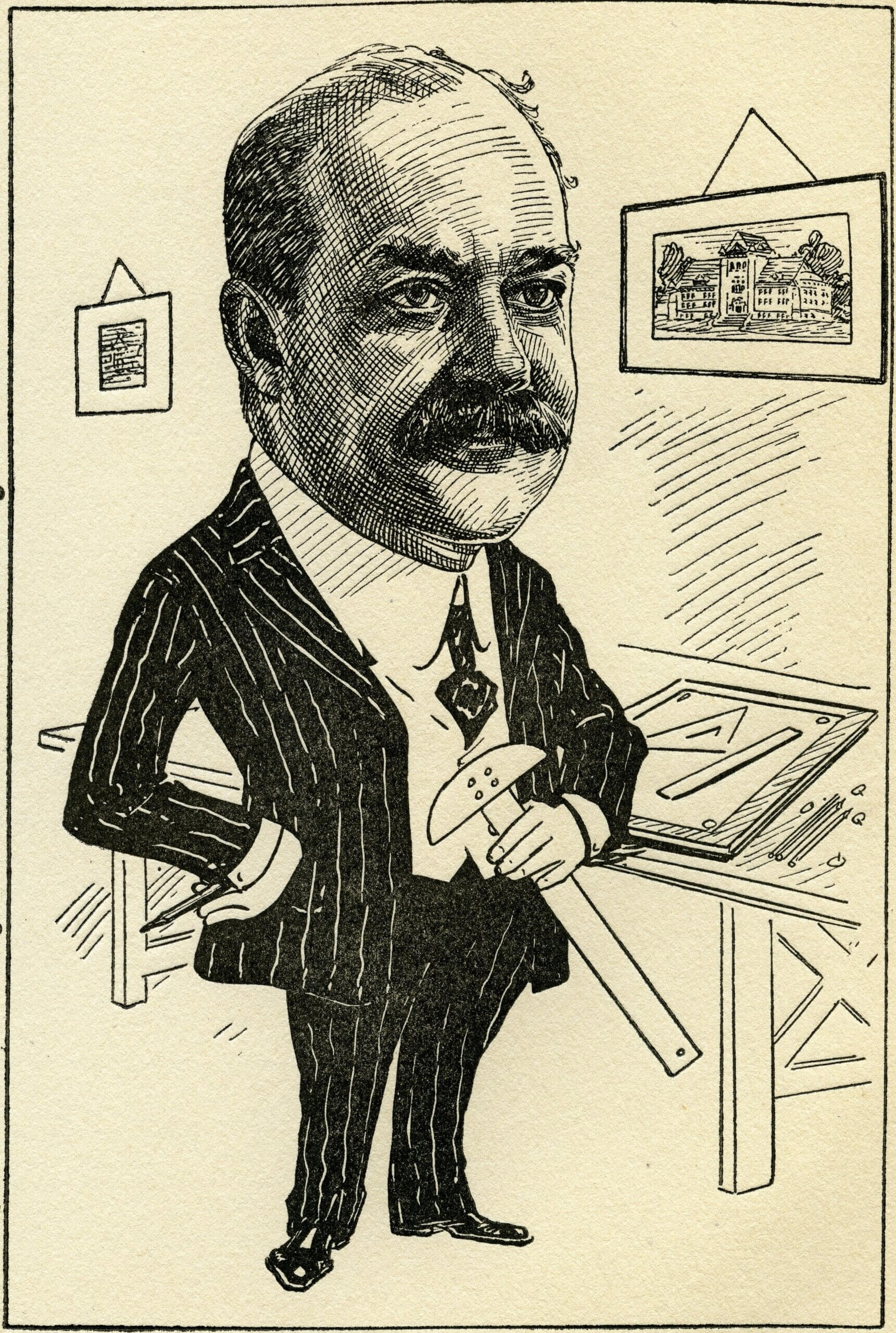
William B. Ittner Caricature, date unknown, from “St. Louisans You Want to Know”.
Missouri Historical Society, P0009-008214.
The classy architectural description would have been Greek to us Sumner students. But we’ve known for more than a century that “Classical” was our Alma Mater’s birthmark.
That distinct heritage created many, many generations of proud, persnickety, and perfectly pompous Sumner students and graduates! Blame it on Sumner’s palatial architecture, if you must! (Perfectly acceptable, if not mean-spirited and hurtful to others, of course.)
In 1909, the late and still-esteemed “Duchess of African American History,” Julia Davis, had earned enough credits to matriculate in the then new Sumner’s second Senior Class. She confirmed to me during a 1970’s TV interview that Sumner was gloriously born a “Latin Classical High School.” Her Class Motto and Class Song, she proudly told me, were recited and sung in Latin!!!!
While I was a proud “Sumnerite,”(1957-1961) the dress code reflected who we purported to be. I called the Dress Code “QP” for “Quasi-Parochial.” For Sumner’s young ladies and female teachers: NO TIGHT-FITTING, LOW-CUT DRESSES NOR BLOUSES. NO SKIRTS FASHIONED ABOVE THE KNEES!! No slacks nor shorts of any sort for females.
For Sumner High boys from 1908 until after what we might call the “Brantley Era”: NO JEANS. EVER!! Khaki pants during warmer months (starched and ironed to razor sharp creases); CORDUROY and wool during colder temps! All shirts (and blouses) had to have collars. No open-toe shoes for any males or females. Socks or stockings with ALL footwear. Penny loafers prevailed. Oxfords, saddle shoes, patent leather. Sandals okay in the Bible. But not at Sumner High.
Male teachers were expected to wear neckties, suits, white starched shirts with collars, jackets, and preferably polished shoes! (1857? Or 1957?)
Sumner High Principal George Dennis Brantley reigned at Sumner High from a remarkable 1928 to 1968. He could remember parents, relatives and your next-door neighbors that had attended Sumner way back when.
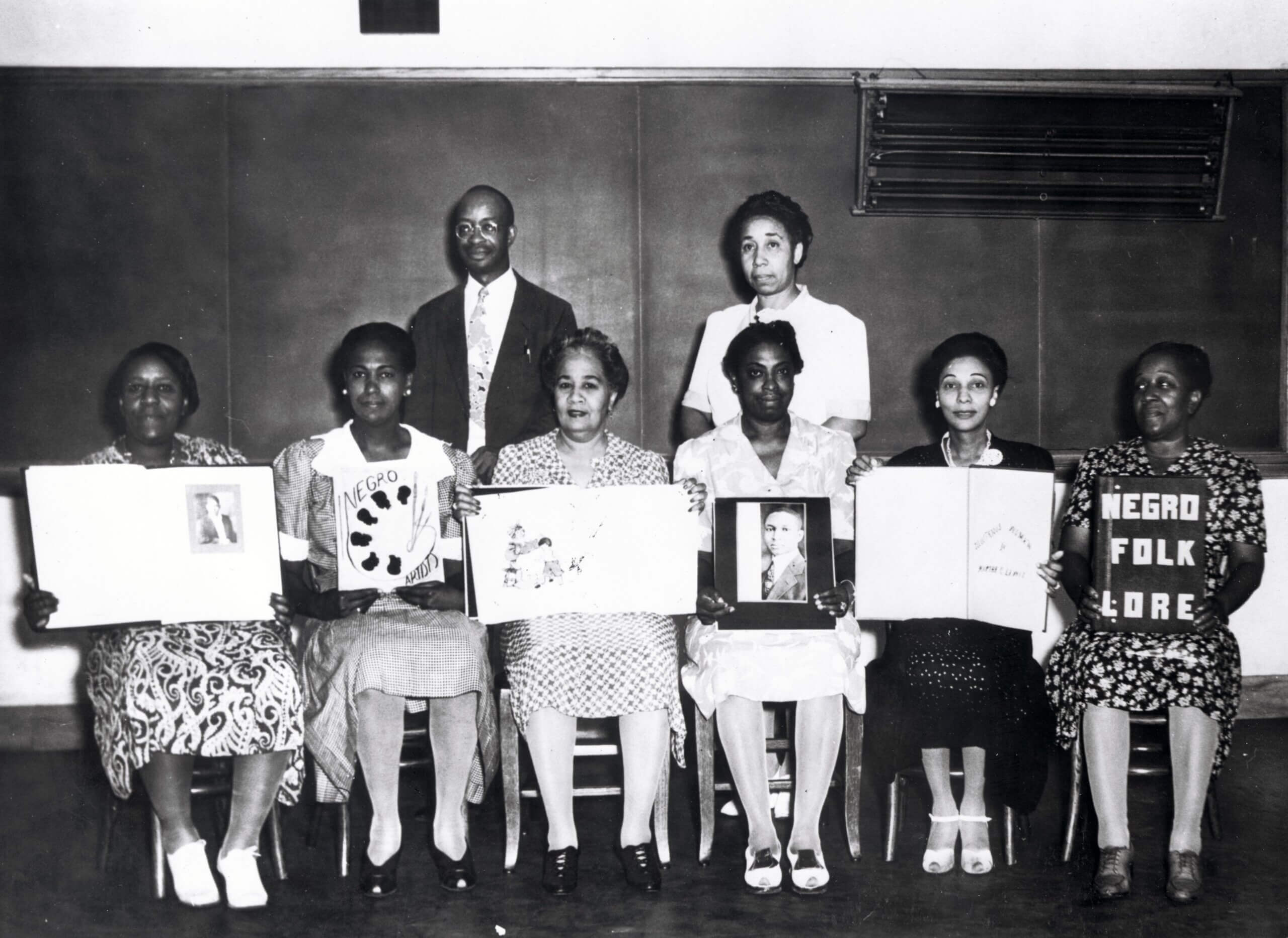
Dr. Herman Dreer and Julia Davis with teachers trained at Saturday School of Negro History,
by unknown, c1935, photograph. Missouri Historical Society, N01783.
Sumner High Principal George Dennis Brantley reigned at Sumner High from a remarkable 1928 to 1968. He could remember parents, relatives and your next-door neighbors that had attended Sumner way back when. Without a doubt and unabashedly Sumner’s supreme “Cheerleader-in-Chief!” Mr. Brantley promoted “Sumner Snobbishness.” For FORTY YEARS!!!
Architect William Ittner went directly from drawing up layouts for the World’s Fair to fashioning the first “high school for colored” west of the Mississippi. Ittner was able to see Sumner evolve into an elite “academy!” Was this what Sir Winston would have called a building “shaping” students, faculty, alumni, and an entire community?
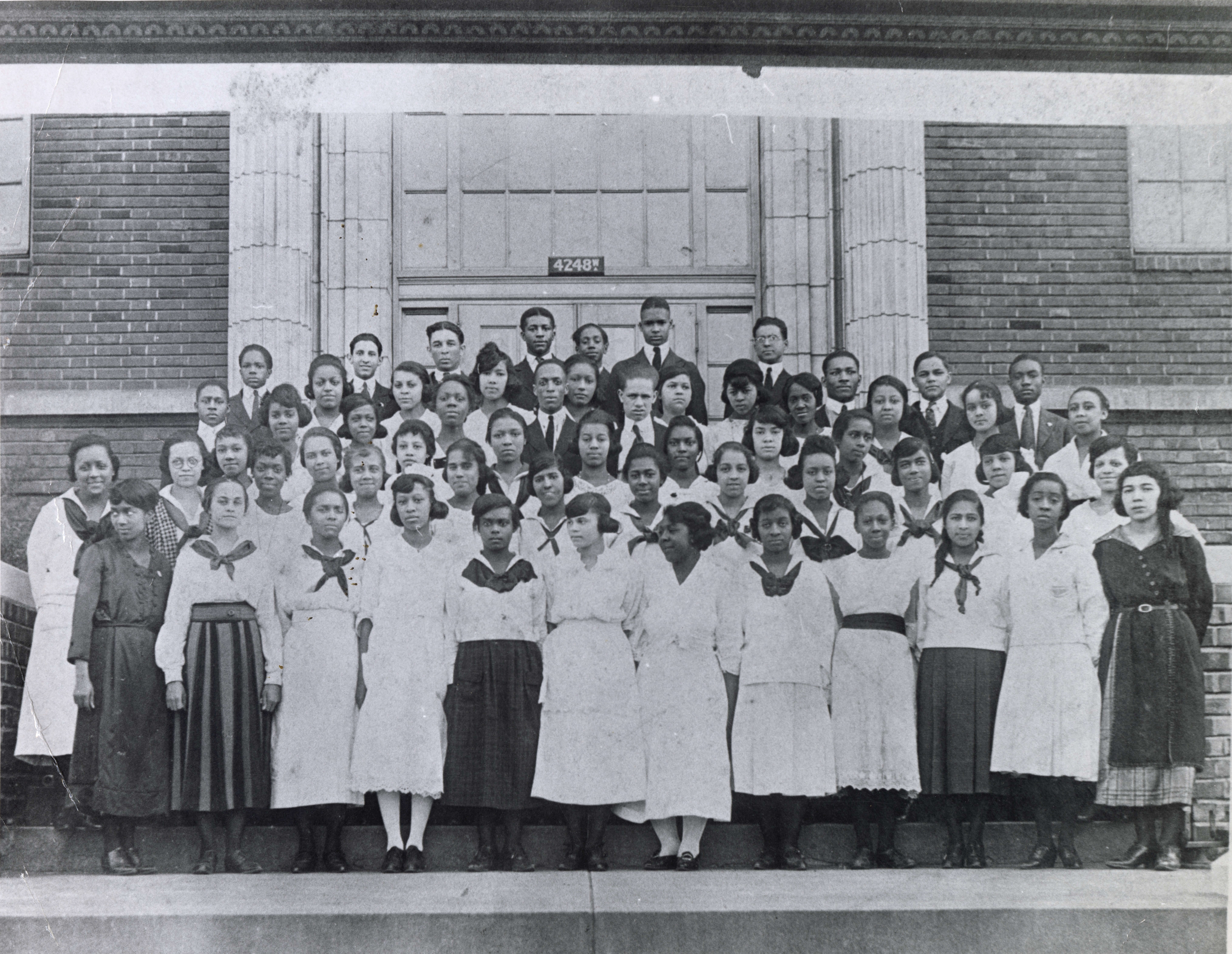
Sumner High School graduating class from 1921 standing in four rows
on the steps to the front of the school, by unknown, 06-1921, Photograph.
Missouri Historical Society of St. Louis, P0203-02148
When I was a student at Sumner, whenever the folks in The Ville saw a couple school buses parked in front of the Ittner Classic near suppertime, it was highly likely the vehicles were to convey the famed Sumner High School A Capella Choir to Powell Hall to perform exclusively with the nation’s second oldest symphony orchestra.
Under the direction of the brilliant Kenneth Brown Billups, the Choir’s repertoire ranged from soulful spirituals to Slovakian folk tunes. At Powell Hall the Sumner A Capella Choir was frequently called on to sing classics with the full orchestra ranging from Bach to Beethoven; Mozart to Mahler and more.
And when there were a couple Greyhound buses parked out front of Ittner’s classic, it was likely an indication that the Choir was off to concertize in places like New York City, Washington, D.C. or Philadelphia.
And in addition to the backyard Ebonics we Sumnerites spoke with fluency, we young choristers were musically adept at French, German, Spanish, Portuguese, Latin, Russian, Dutch and/or Italian. And more. (See Carmina Burana and Cavalleria Rusticana. Both performed by the Sumner A Capella choir/SLSO/Powell Hall.)
And here’s something else that would have surely made William Ittner particularly proud: Each and every local concert appearance and each road tour was prefaced on the printed program by a robed group picture of youthful choristers posed on the Sumner High front steps — framed by our Ittner palatial high school’s architectural classic frontage. The photos underscored who we were… and from whence we came.
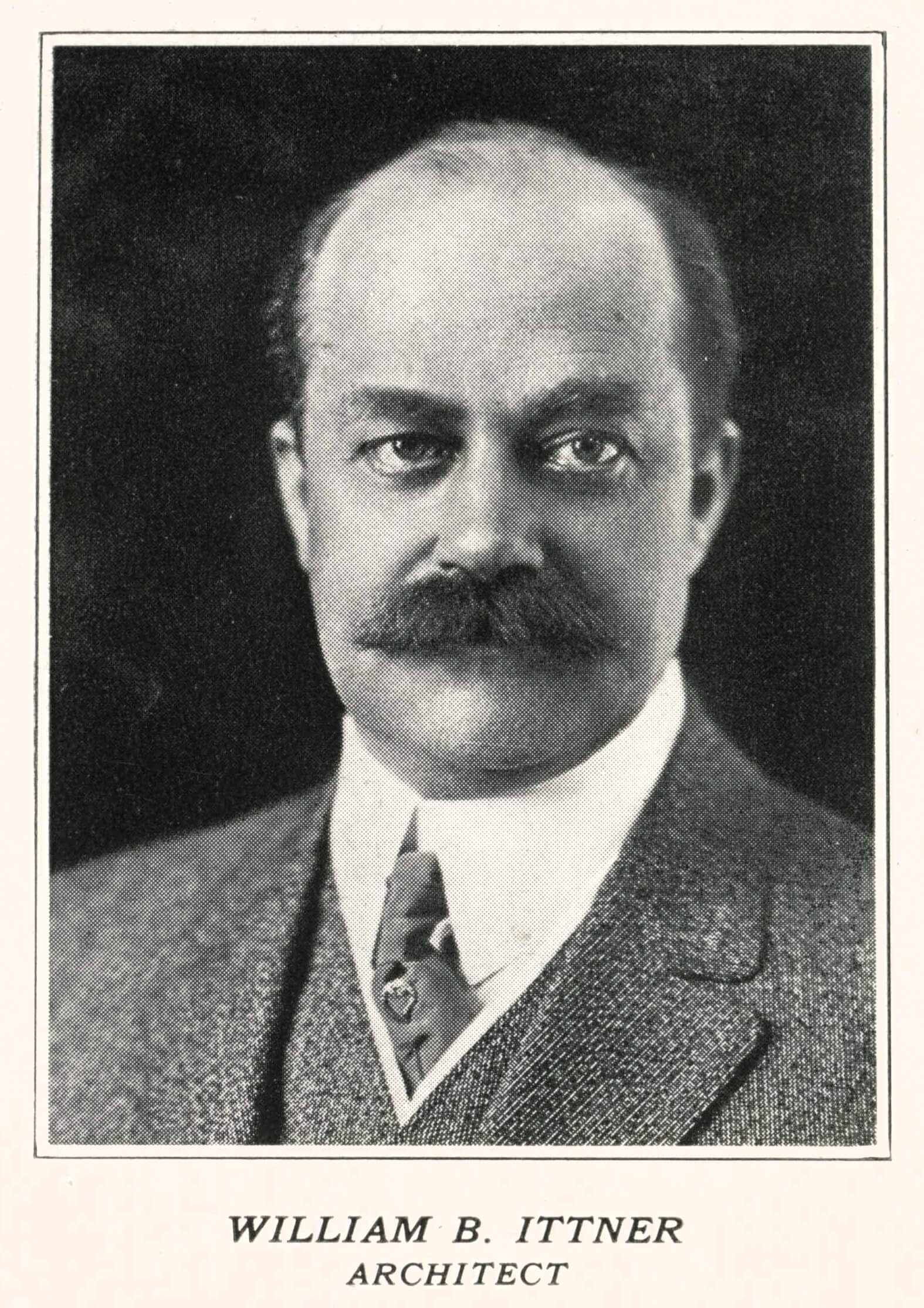
Portrait photograph of William B. Ittner (from Portraits of Prominent Saint Louisans in 1916). Missouri Historical Society.
“Churchill was right after all. We shape out buildings…and then our buildings shape us.”
Before Sumner High, there was no other public high school in St. Louis for Blacks until Vashon High School was born in 1927. No Roosevelt, Central, Southwest, McKinley, Beaumont or Soldan High Schools rolling out a red carpet (or other school colors for Blacks in St. Louis) until sometime after the 1954 Supreme Court Decision. There was certainly no “deliberate speed” in STL public school racial integration. So, a couple key questions here: “Should Sumner High School Students — beginning in the very earliest sector of the 20th Century — have rightfully developed attitudes of pride, elitism and even a certain measure of “snootiness?” And were those elements propellant “shapers” for success? Wonder what Sanger and Ittner would have thought? Churchill was right after all. We shape our buildings…and then our buildings shape us.
Katie Graebe, July 2026
After-School Snacks!
A few bite-sized tidbits from St. Louis Public School history, from Julius Hunter’s Snack bag.
St. Louis public schools did not have indoor toilets until 1898, when William Ittner installed the first ones at Eliot School.
- The St. Louis School District banned married female teachers from employment until the Missouri Supreme Court ultimately ruled the policy unconstitutional and lifted the ban in 1948.
- Some St. Louis Public School classes were taught in German from the end of the Civil War until World War I.
- William Ittner’s father was a bricklayer turned brick manufacturer.
- After designing more than 50 schools, Ittner resigned as school architect in 1910 but continued as a consultant.
- Cole School at 3915 Enright Ave, was formerly Von Versen Street before WWI.
Part II
Becoming a Teacher: Harris Teachers College
Post-Sumner High, with not a single Ivy League college pursuing me, I looked to the then enigmatic Harris Teachers College. I was told the school was somewhere right down the street — immediately west of where I lived in the 50-hundred block of Kensington. In the movie, MEET ME IN ST. LOUIS, the houses on Kensington looked more like the mansions on Portland/Westmoreland Places than the humbler houses a block west of me on Kensington!!
How odd that I had not ever seen “down-the-street” Harris Teachers College (HTC). Nor had any of my neighbor-buddies had reason to pass in front of this school.
STOWE Teachers College (STC) had been opened to train “colored” teachers — under the tutelage of all Caucasian instructors! This racial composition was still going on ten years after Sumner debuted in “The Ville.”
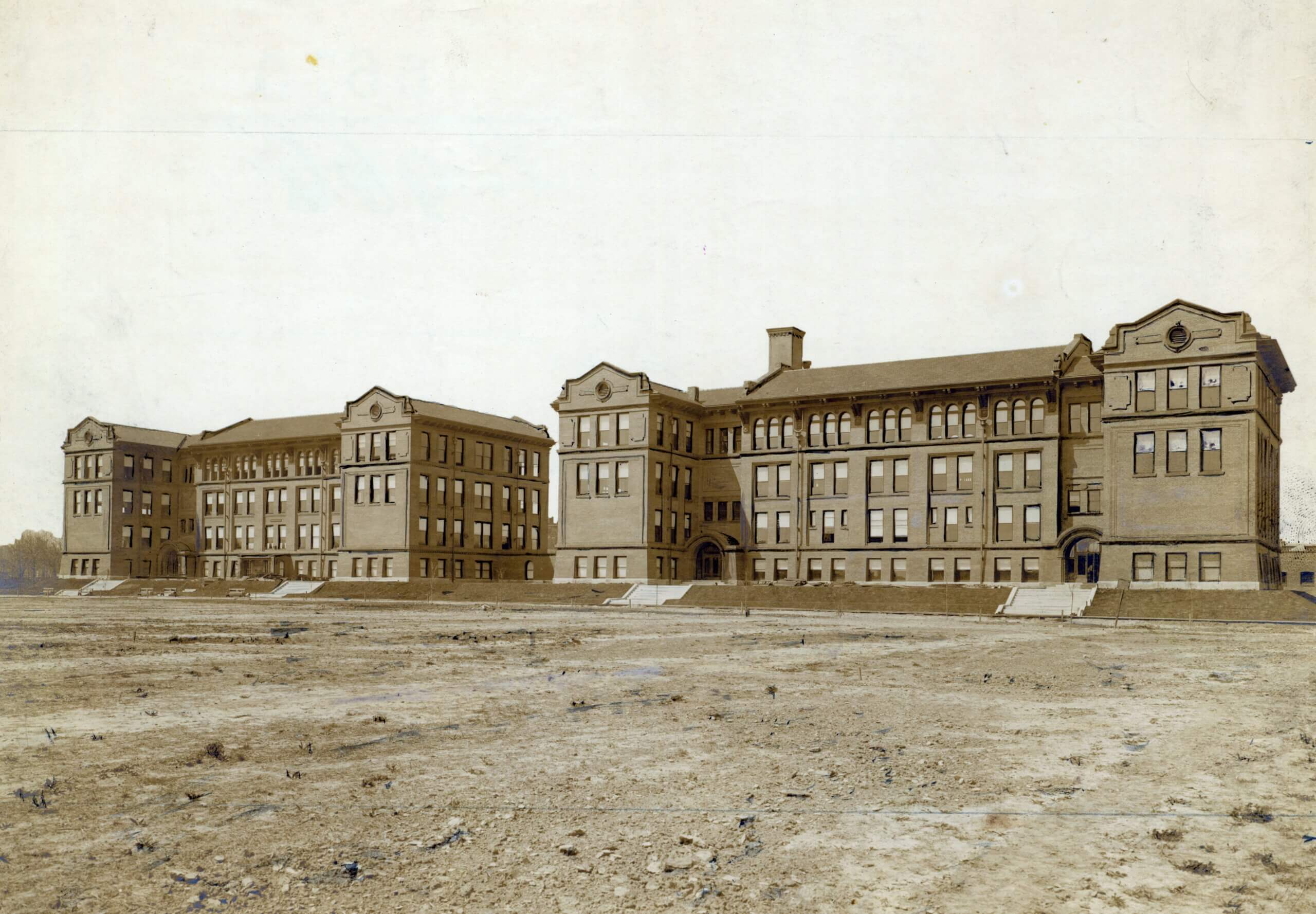
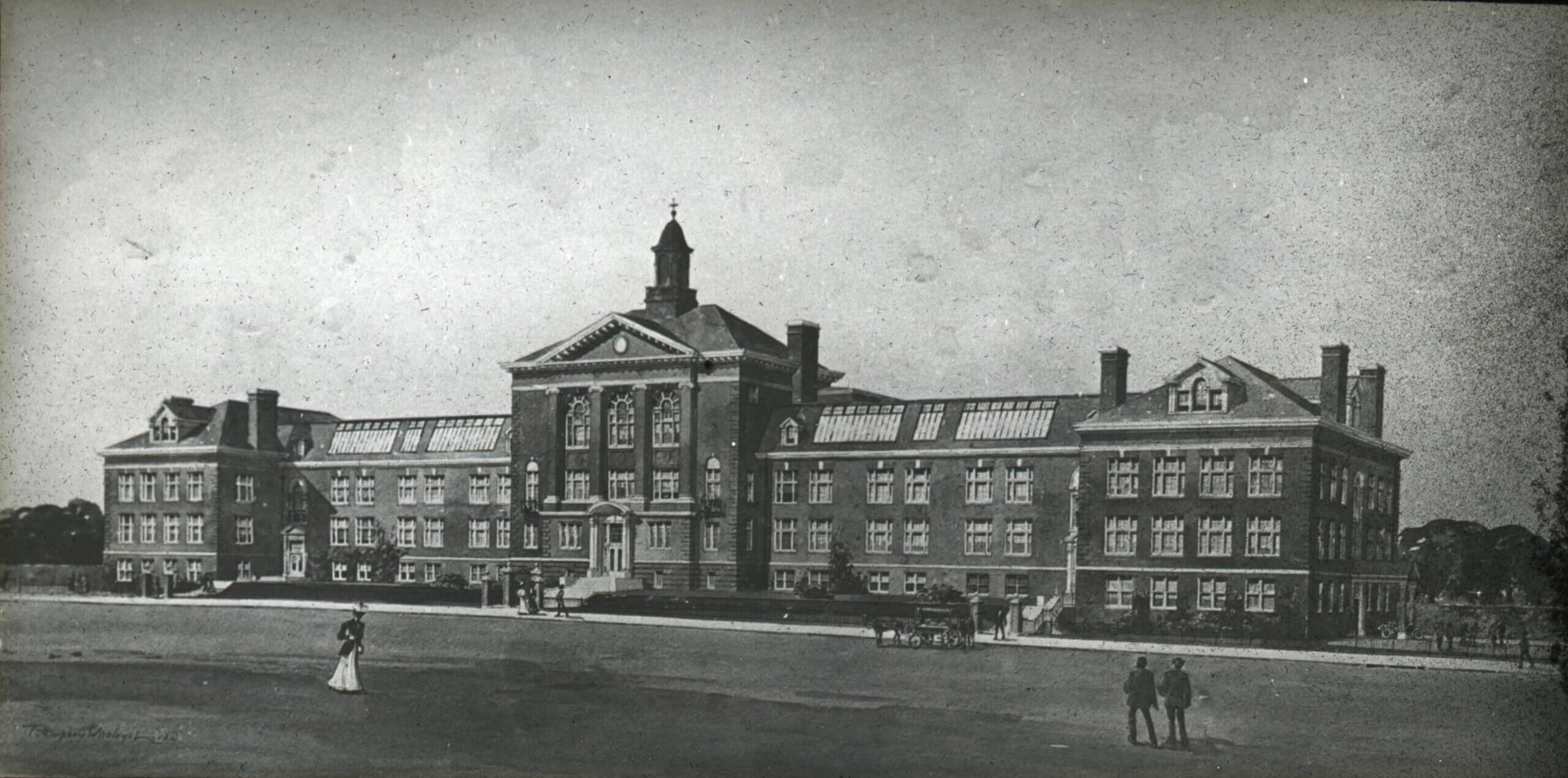
Smith Academy and the Manual Training School. 5351 Enright Avenue,
(original Harris Teachers College) by unknown, c1910, photograph.
Missouri Historical Society, N34797. Copyright Undetermined.
STC was eventually located just across the football field from Sumner High.
It was in the former Simmons school, 4318 St. Louis Ave. at the edge of the Ville, prior to the 1954 merger. We Black students knew about Stowe, of course. It produced “our” teachers.
This Harris Teachers College campus, designed by Mauran, Russell and Garden, opened in 1905, just as the Big Fair closed. Initially open to WHITES! This school had gradually — and some would say rather reluctantly — opened its doors to Blacks following the 1954 Supreme Court Desegregation (“deseg”) ruling.
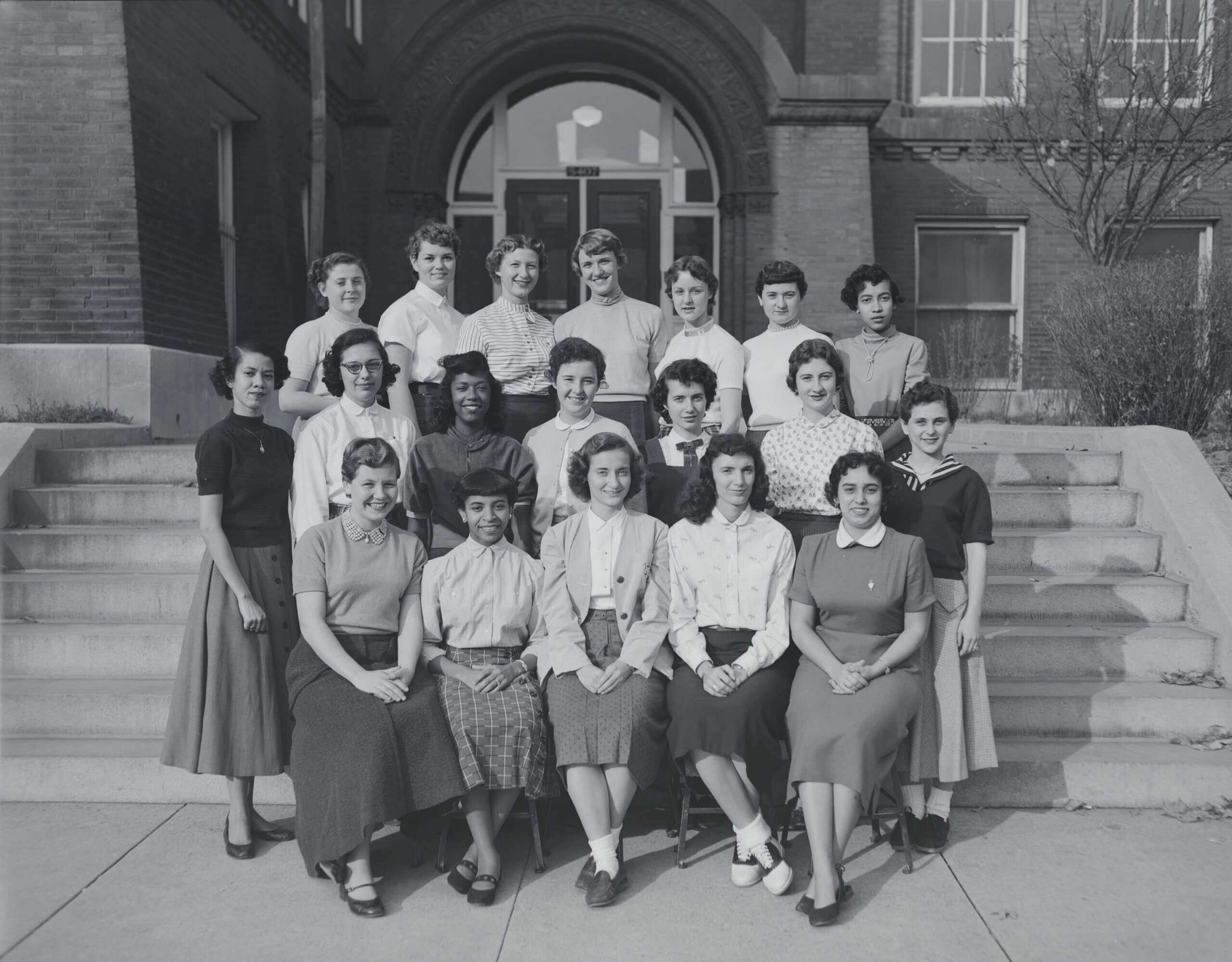
Integrated group of women posing for a photograph Harris Teachers College by Sievers Studio,
11-1954, Negative. Missouri Historical Society of St. Louis, P0403-54559-64-4a.
Harris Teachers College was not located on a well-traveled street by any means in those pre-GPS or drone days. Once discovered by explorers, though, the building sat atop was sitting high atop a three-tiered plot at 5351 Enright Avenue. There was only one way onto the one-way Enright Ave… and only one way out. NO THROUGH TRAFFIC. Intentional, no doubt.
As an “applicant,” my “Sumner “snootiness” would never allow me to appear to be an ignorant “supplicant” seeking admission. But taking a deep breath, I walked the two blocks west and then up the stairs leading to the Registrar’s office. I found the front desk personnel to be robotically, politely icy. No red carpeting. No trumpets blared.
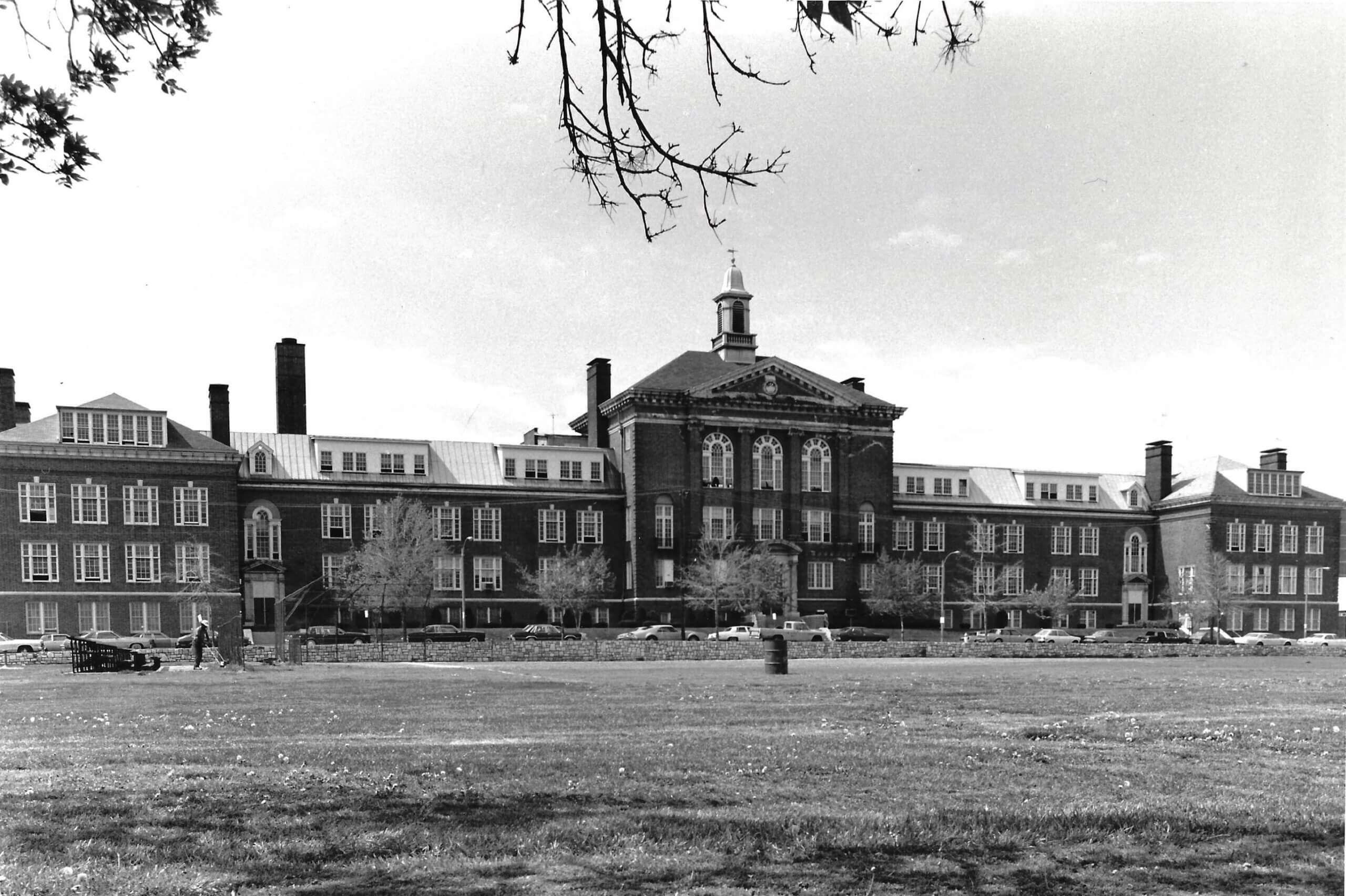
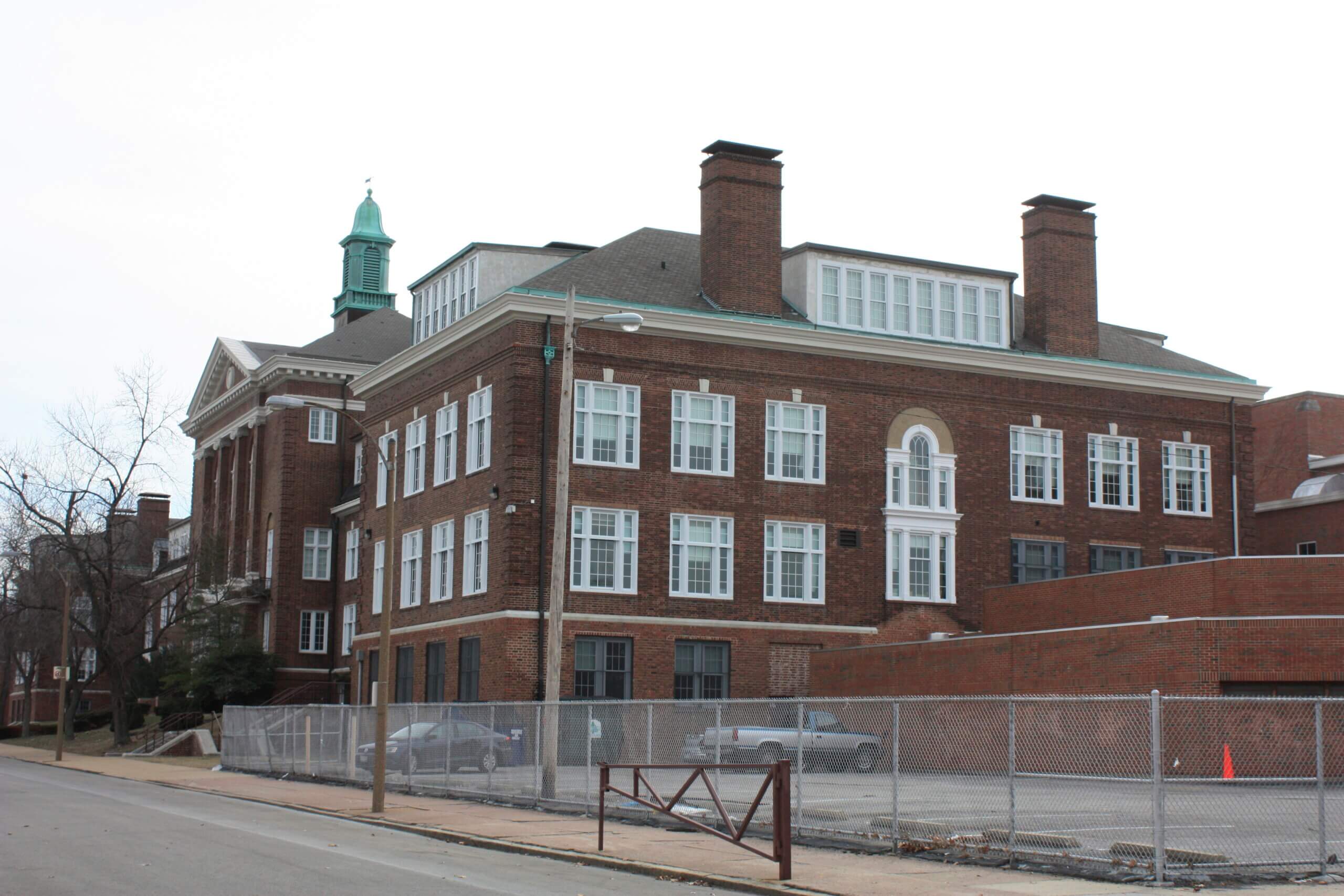
The Harris Teachers College setting was really verdant. Lovely green space enveloping the bricks and mortar. Constructed in 1905-06 upon seven acres, it consisted of two dark red brick school buildings and a shop, interconnected by hallways. The school building had so many names since its Mauran, Russell, and Garden design. While the firm designed some classic buildings and broke St. Louis away from Beaux-Art and into the classical era, we’ll save that story for another time.
Here they created even smaller classrooms for prospective teachers than were drawn up for Sumner High School. We later learned that HTC’s smaller classrooms were intentional. Relatively small because there were few Caucasian teacher candidates at the time HTC opened in 1905.
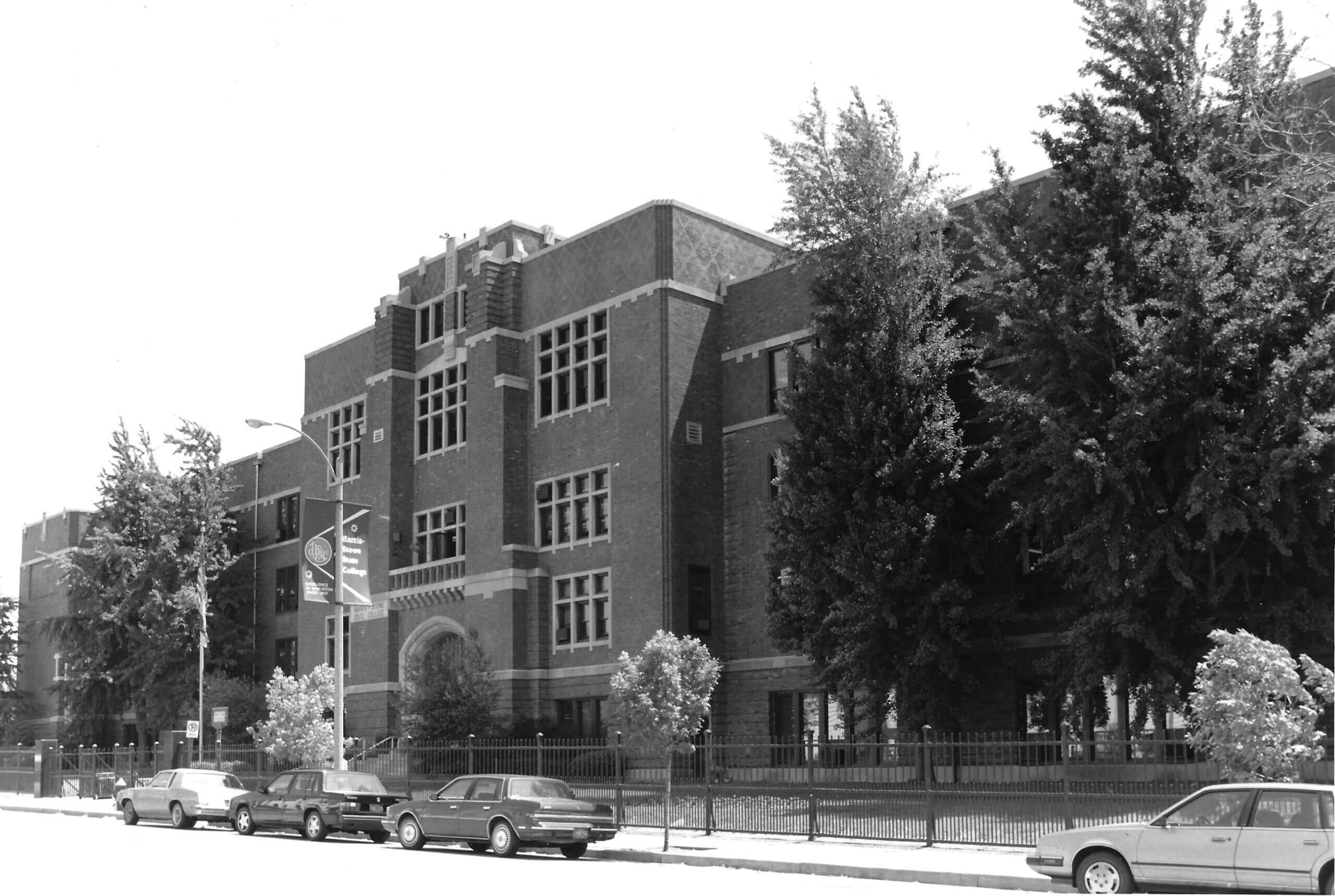
Harris-Stowe State College, 3026 Laclede Avenue. #50/68 Cynthia Longwisch, 1988.
Landmarks Assoc. School Architectural Survey
I learned, with an audible “Whew!”, that I had been accepted at the heralded, but hidden HTC immediately west of Union Avenue. Next… I began to quietly ponder how I would ever raise a semester’s tuition: “$70 + books.” Odd jobs!! Gardening in Ladue. Bussing tables in Gaslight Square. Becoming organist at a tiny Lutheran Church.
Caucasian students, faculty and staff often appeared to exhibit more curiosity than welcoming warmth to the Newcomer Group. And we members of the Incoming Group of color might have been only cautiously, awkwardly friendly outside our pods. The “mixing” had just begun in 1954-55… not even a full decade after my high school graduation.
Looking at both the HTC and the STC settings side-by-side, neither of the two campuses had come even close to satisfying the U.S. Supreme Court’s theoretical “school deseg ruling.”
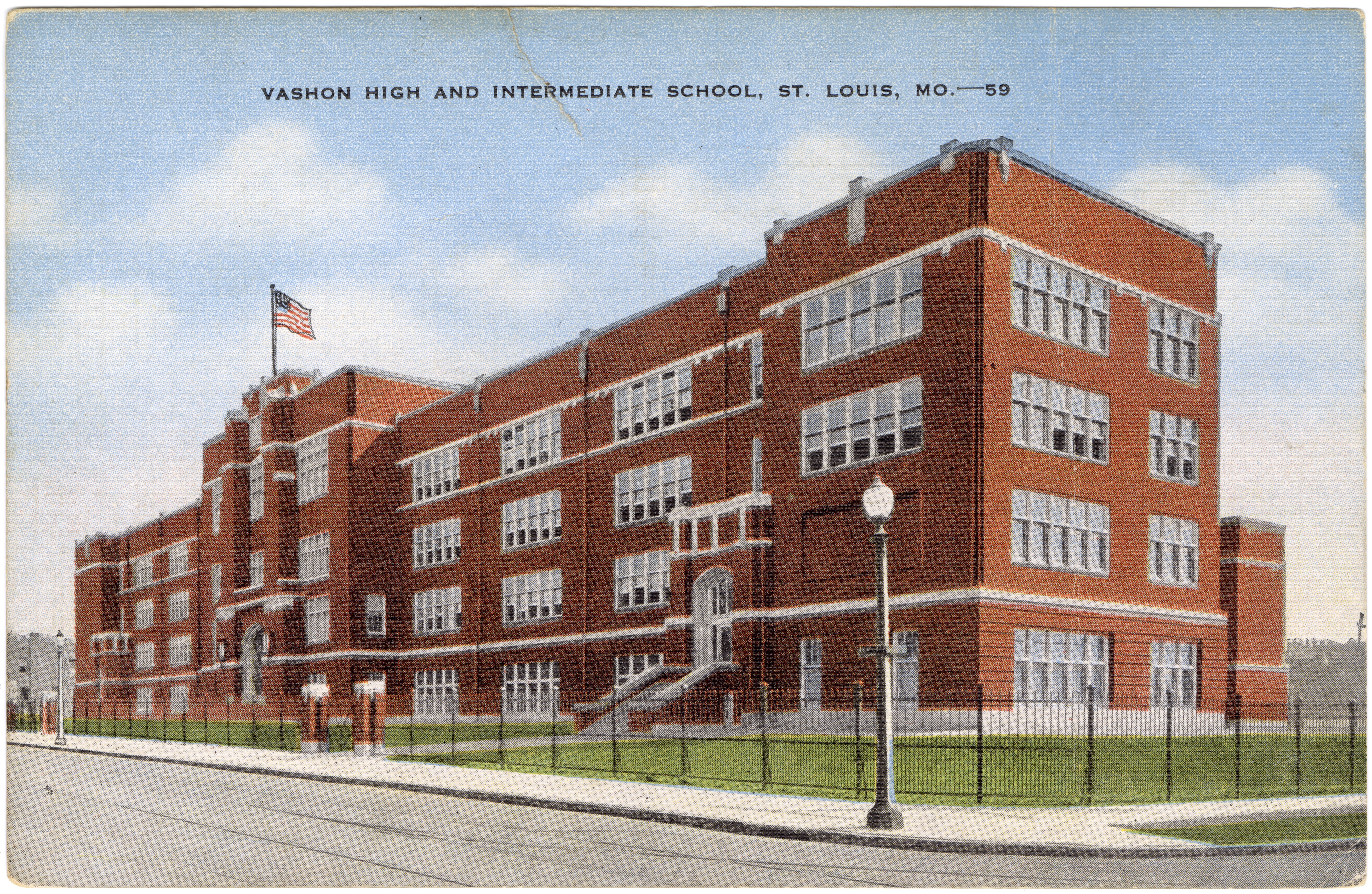
Vashon High School Postcard, St. Louis Greeting Card Company.
Missouri Historical Society, P0363-00112.
There were still some wisps of discomfort in the air. From both sides. It was whispered in almost audible shock that the Stowe Teachers College faculty — pre-merger — had at one time been paid 1/3 the take-home pay of the Harris Teachers College teachers. Research showed it to be a sad-but-true fact.
The STL Public School Board had designated Stowe instructors as “teaching assistants” to keep their paychecks small. That, thankfully, changed with the merger. But shadows haunted and hovered over the ugly truth on the newly mixed HTC campus.
We could never substantiate the ugly rumors that standards had been lowered to allow a bunch of lesser-qualified students in to satisfy the desegregation ruling. We worked harder to dispel that misinformation. And the eventual 4-hour National Teachers Exam everybody had to pass proved that rumor to be untrue.
Fraternities and Sororities were strictly racially segregated in 1961 when my Sumner and Vashon-grad friends and I arrived at the HTC campus on Enright. The three-story HTC main building sat elevated on the north side of what appeared to be an open-park setting. Putting the design elements aside, the people using the campus became unwitting participants in a pattern of racial separation. The patio area was alternately and sporadically racially segregated for quite a period. The design schematic tried hard not to contribute to racial segregation. But it ultimately did.
“The design schematic tried hard not to contribute to racial segregation. But it ultimately did.”
Though not mandatory, nor even designated… cafeteria klatches, outdoor smoking breaks, card games, billiards or ping-pong tournaments became inadvertently quarantined or invisibly cordoned off by race. So-called “Sock Hops” remained epitomes of segregation. Engineered by both sides. In fact, campus spaces remained separate but somehow equal for quite an uncomfortably long time after racial segregation officially ended. A table predominantly of one race or another on the HTC campus slipped away from quasi-racial integration, morphing into a greenspace or cafeteria area for the eventual majority. The scene was initially edgy. Awkward. Daily. Hourly. Depending on one’s hue.
“Our side” imagined or nailed it when certain professors did not seem to want “us” there. I’m sure this was true for the “other side,” too. That made “us” work extra hard to gain undisputable high marks from those students and profs who did not appear to want us there.
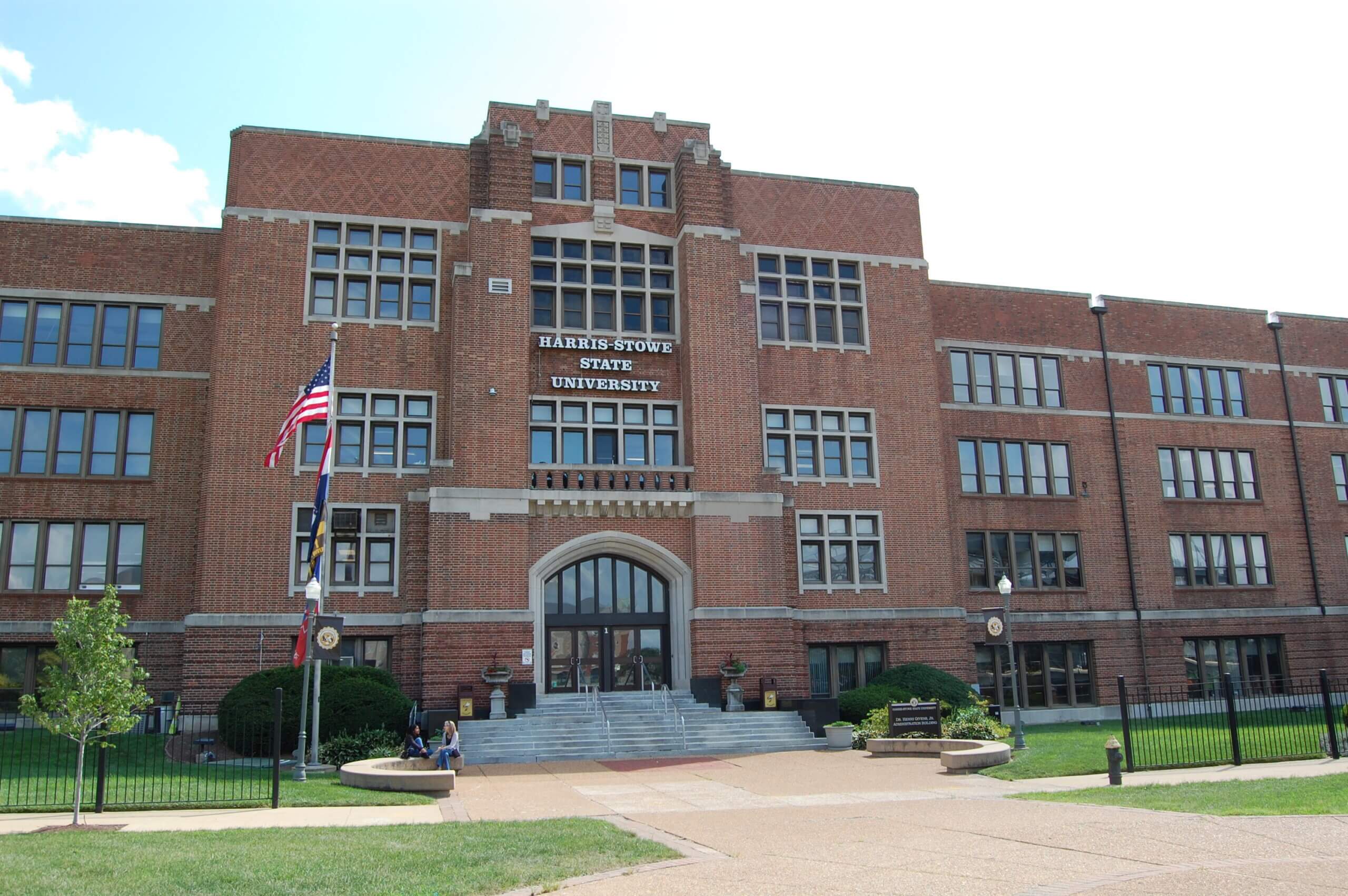
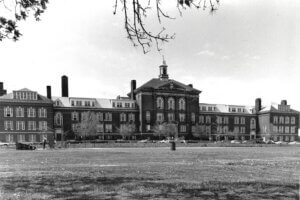
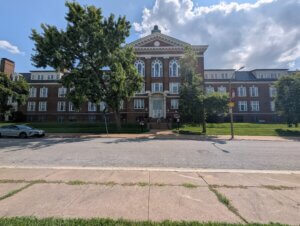
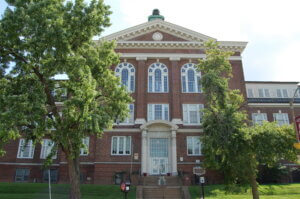
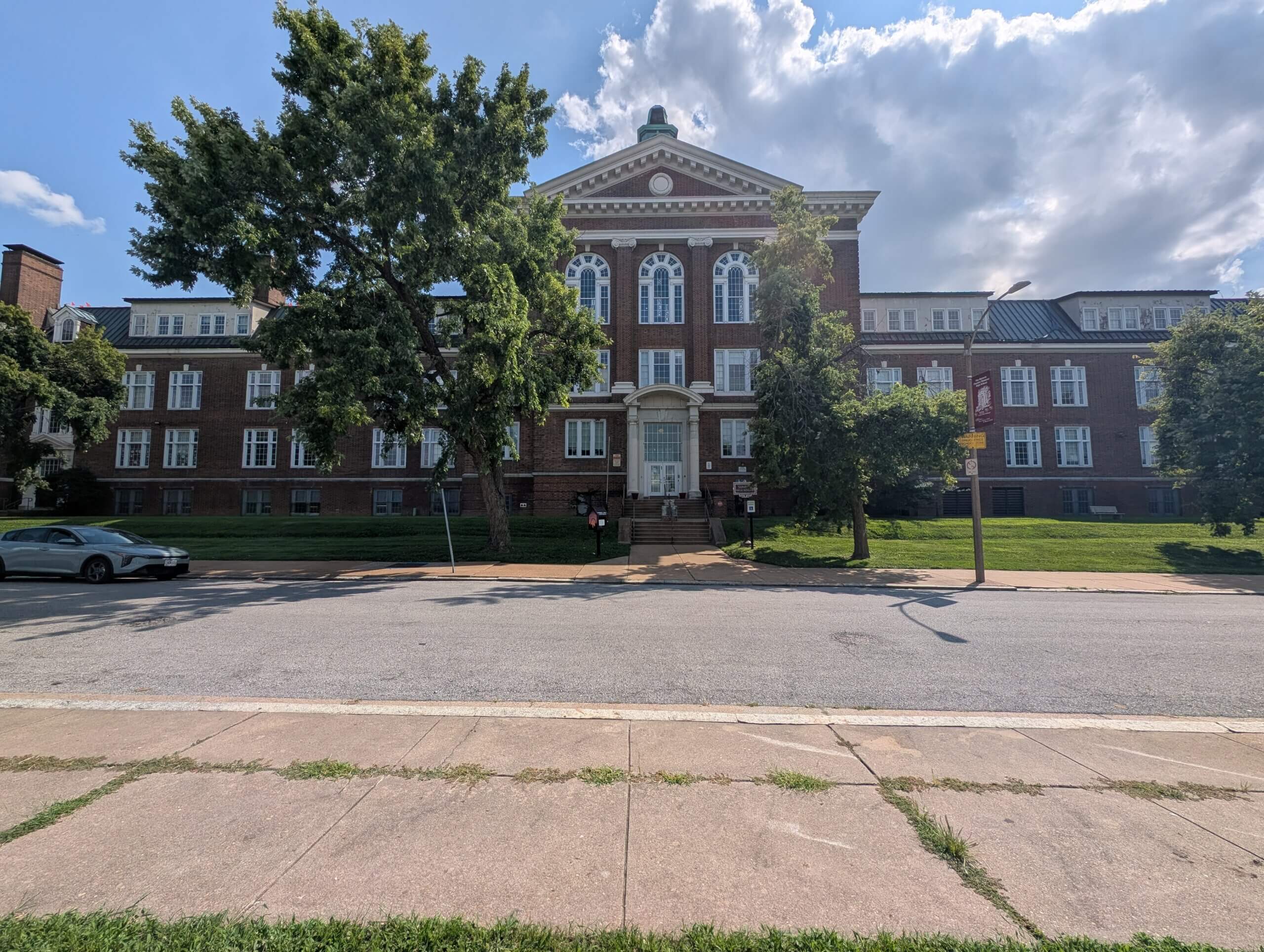
Harris-Stowe State University, 3026 Laclede Ave, Katie Graebe 2026
One legendary unintentional racial clash of cultures occurred after HTC moved from its Enright Avenue hideaway into the former Vashon High School and current HSSU building on Laclede in 1963.6 The incident caused sub rosa chuckling for quite a few years after it happened on May Day, the year of the campus relocation. That’s when my all-Black Omega Psi Phi Fraternity’s admittedly raucous-by-design “step- march” routines unintentionally interrupted –some say “shattered!” — a prim and proper White-sorority’s’ historically traditional “May Day Fete”.
The traditional First-of- May’s maypole observance can be traced back to Ancient Rome honoring Flora, the goddess of Spring, flowers and fertility. The ritual on the HTC campus involved female dancers intertwining strands of pastel-colored crepe paper around a “Maypole.” Flute, harpsichord and string music accompanying the light, lilting vernal dance.
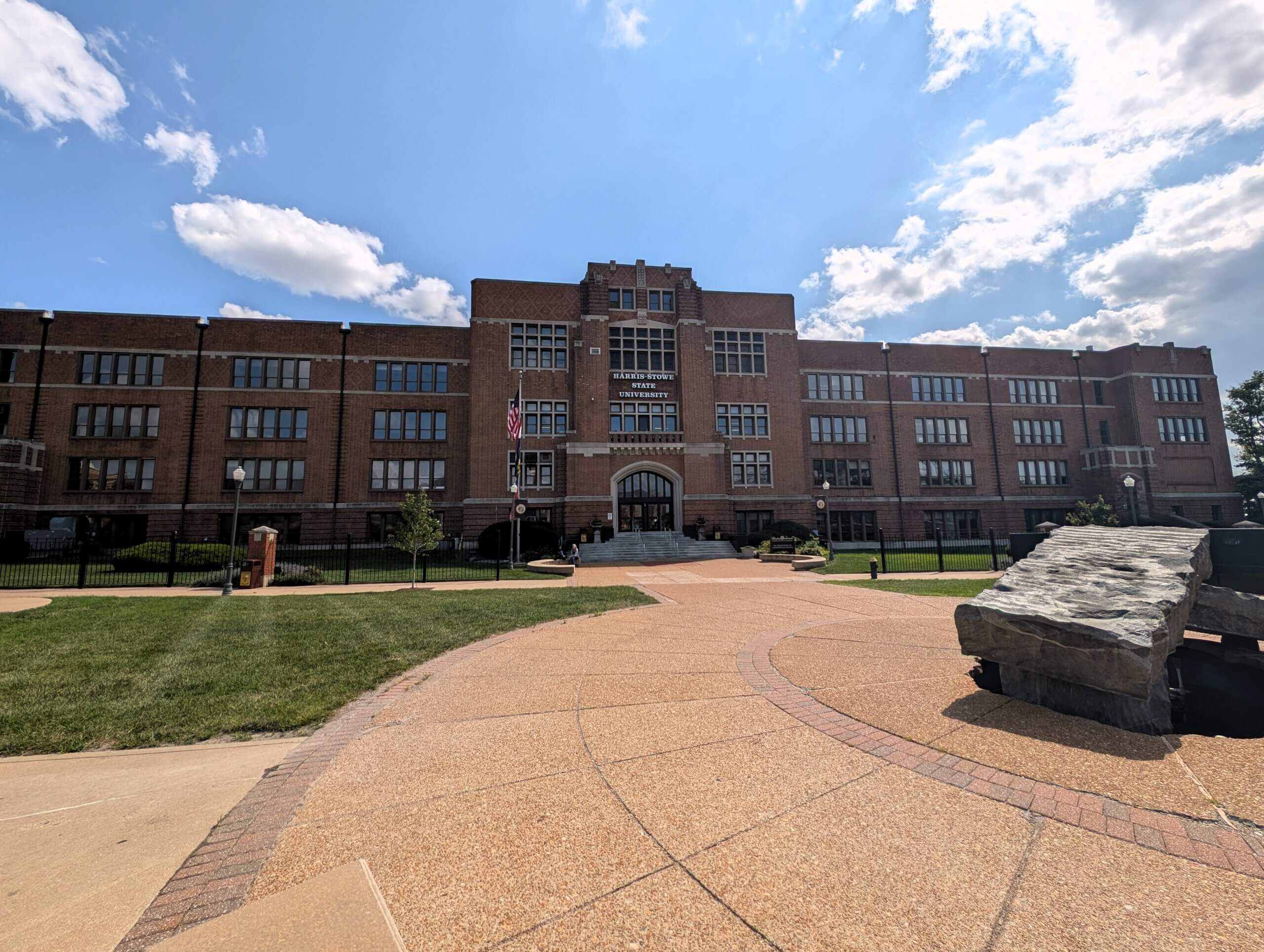
Harris-Stowe State University, 3026 Laclede Ave, Katie Graebe 2026
Now, fancy that serene scene giving way abruptly to a Black fraternity’s intentionally loud stomp marches. The Commissioner of School Buildings might have put his hands over his eyes and ears in reaction to that non-violent, but embarrassing clash. He might have also smiled. Or snickered.
After the inadvertent clash, our frat was summoned and given a stern threat of suspension by the college’s unofficially “designated Black administrator.” No more interference with an historic White HTC tradition.
“THEY were here first, after all,” we were reminded in a near wink and whisper. We pledges pledged to the former Stowe administrator that there would be no future interruptions. Till the end of time. (The Black “scolder” held a double Ph.D. in Latin and German from Pennsylvania University. Credentials not at all rare for the STC transplants!)
We took the reprimand in stride, so to speak. After all, for three years in a row, Omega Psi Phi fraternity won the traditional HTC “Inter-Frat Sing” competition, under my direction. The singing competition was, thereafter, completely shut down. Forever, perhaps.
We took the reprimand in stride, so to speak. After all, for three years in a row, Omega Psi Phi fraternity won the traditional HTC “Inter-Frat Sing” competition, under my direction. The singing competition was, thereafter, completely shut down. Forever, perhaps.
The Practice Teaching and Apprentice programs at HTC provided my classmates with excellent experiences inside classrooms as requisites for graduation. But it didn’t take much detective work to note that Caucasian students were infrequently sent to a school in a Black neighborhood, African American HTC students were almost never sent to schools in predominantly Caucasian neighborhoods.
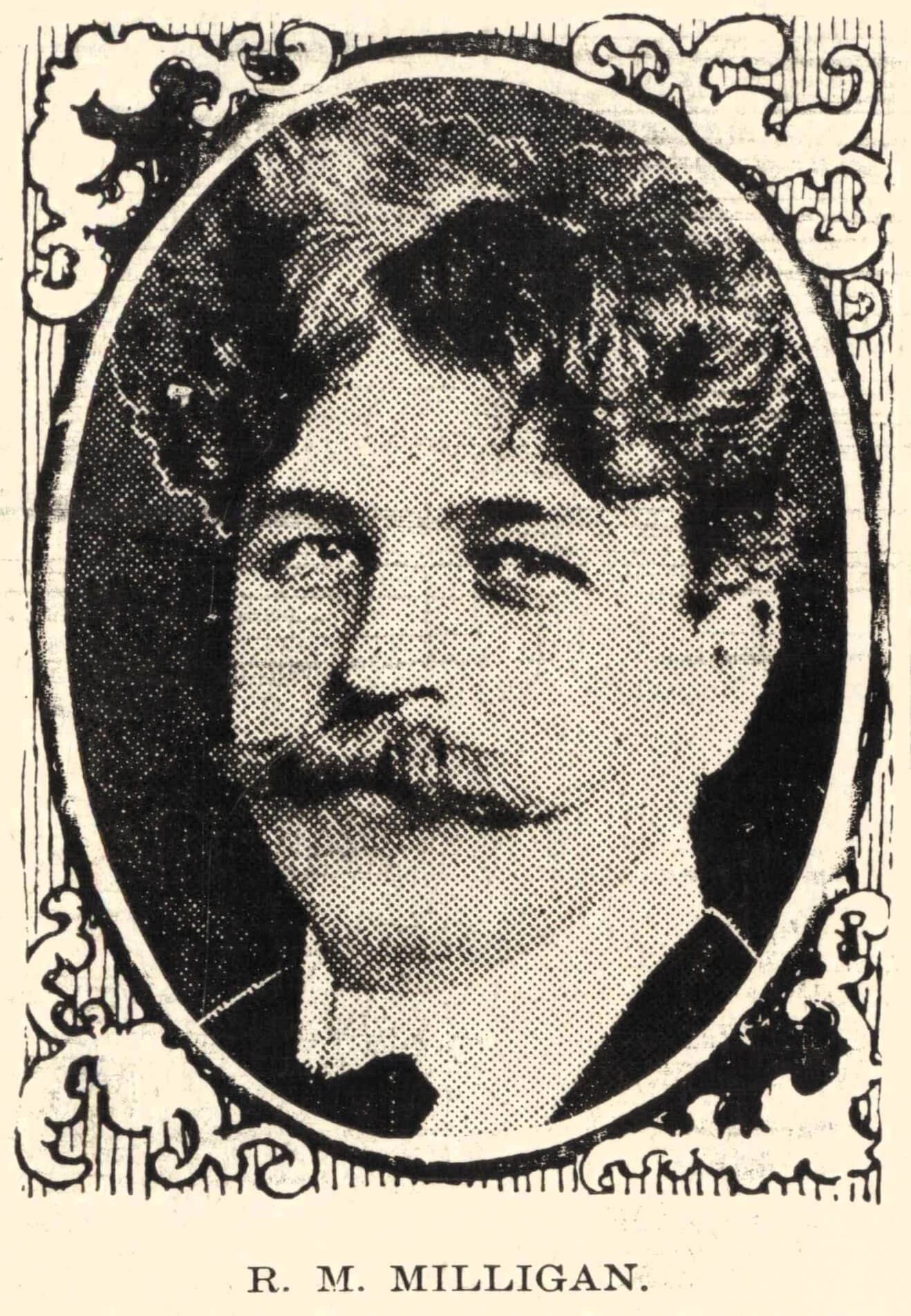
Portrait photograph of R.M. Milligan (from the Inaugural Edition of the St. Louis Star, March 13, 1904). Missouri Historical Society of St. Louis
Passing It Forward: Hamilton Elementary School
I was dispatched in September of ’65 to my first full-time, fully credentialed teaching job. The School Board had served my fellow graduates and me (“me,” not “I”) with our Fall teaching assignments to prepare for over the summer.
Hooray! A full annual salary of $5,250. And almost all teachers were known to snap up SUMMER JOBS!!!
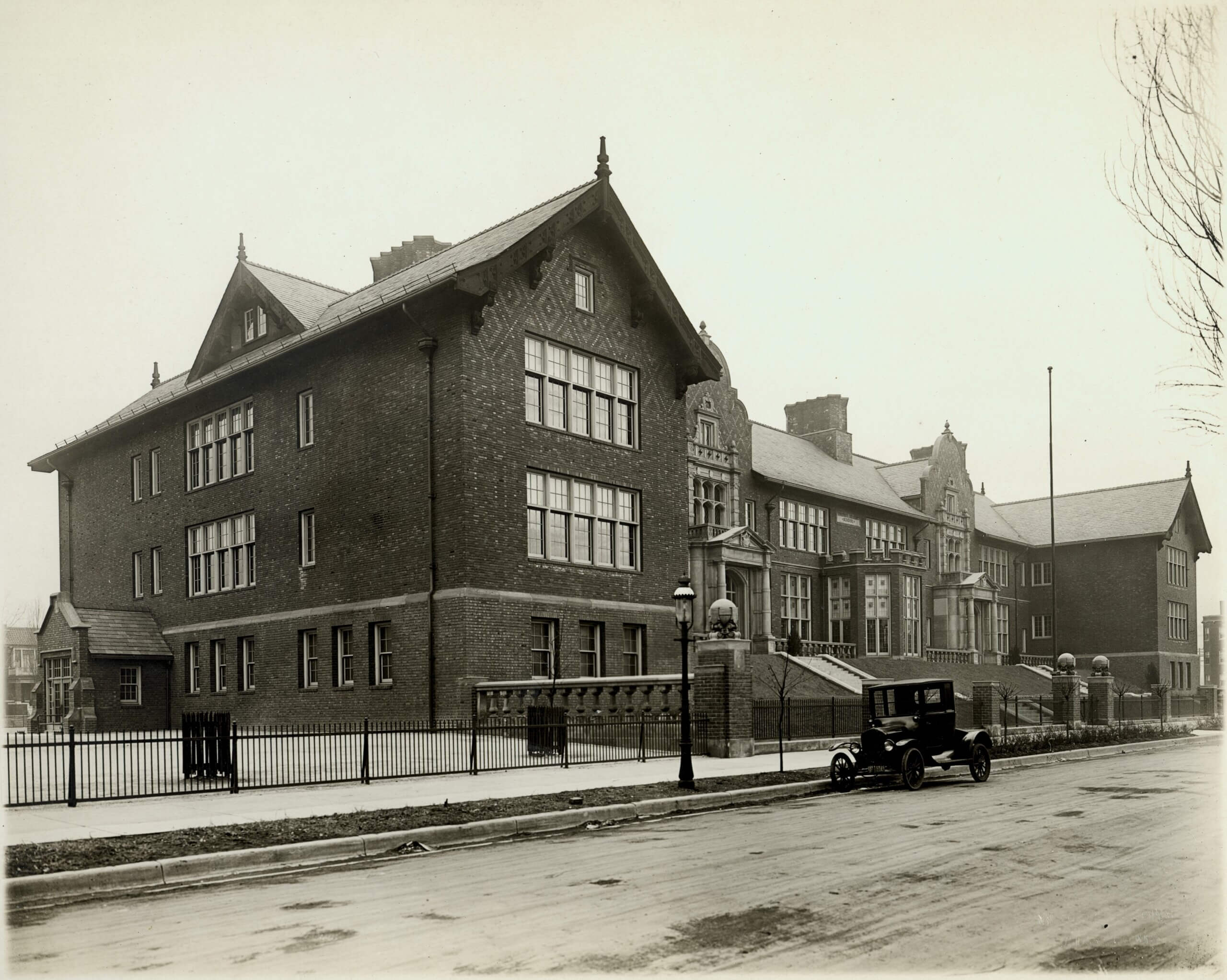
Hamilton School, 5819 Westminster Place, Photograph by. W.C. Persons, c. 1920.
Missouri History Museum, N11315
After passing that mentally rigorous Four-hour National Teachers Exam (now “Praxis”), I was mailed an official School Board assignment notification. Come September, I would be teaching Sixth Grade at the Hamilton Elementary School on the western edge of the City.
I would learn that Hamilton Elementary School was designed by Ittner disciple and Canadian-born architect, Rockwell Milligan.
He accepted the job of designing St. Louis Public Schools in 1914 when his mentor, Ittner, formally stepped aside. But the “dean” of St. Louis’ public schools volunteered to stay on as a consultant.
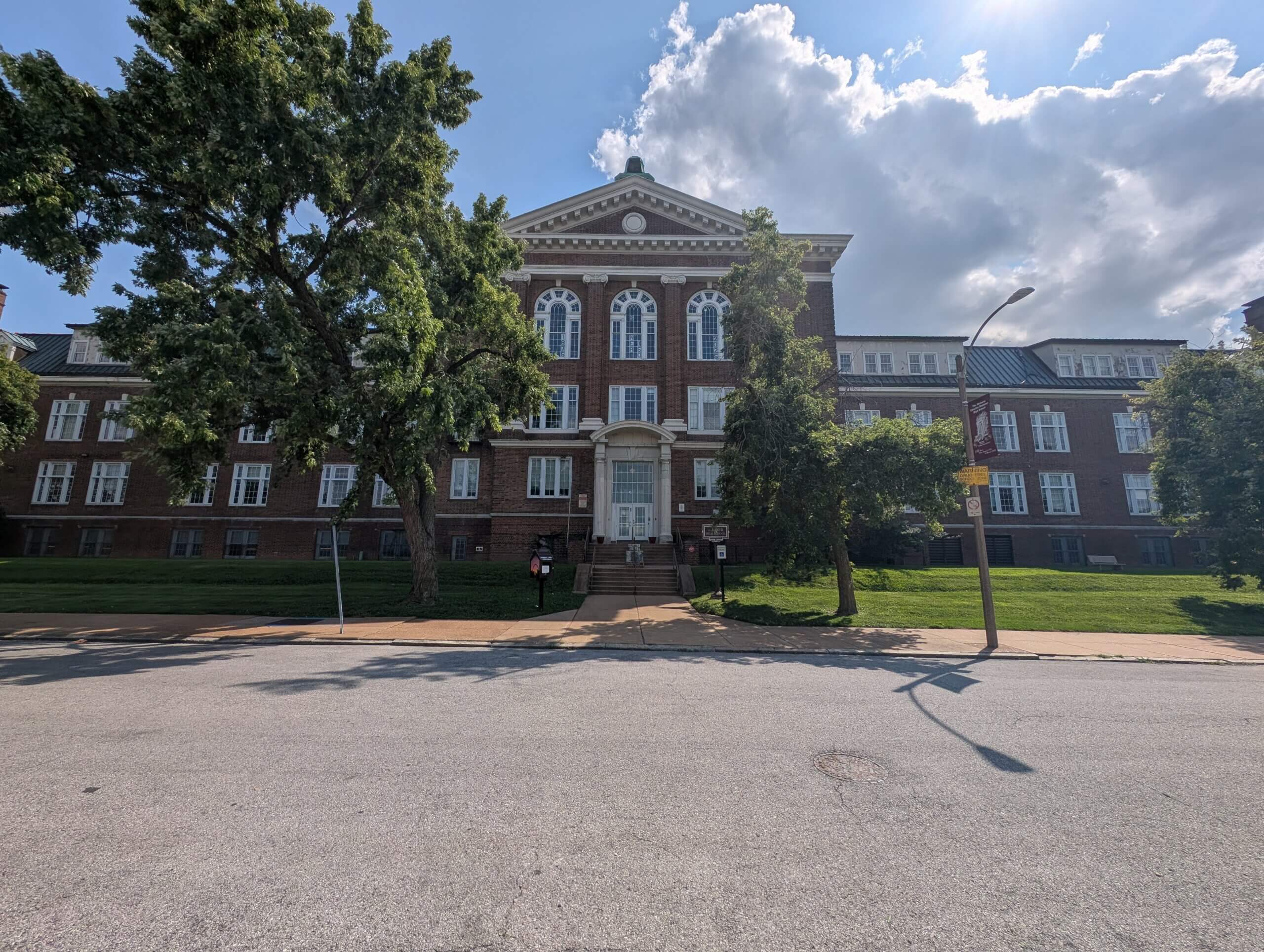
In his assessment of Hamilton Elementary School, Chris Naffziger sees “two identical front portals flanked by perpendicular classroom wings creating two T-shaped hallways.” And Naffziger calls the Hamilton Elementary School design “an interesting fusion of the Tudor Revival and also Hanseatic Northern European Mannerist elements.”
Can’t say I was capable of even beginning to put it quite so eloquently as Chris.
I immediately drove out on the first Saturday following my official assignment to check out my new job site’s placement.
As I strolled up and down the front, sides and back of the school building, I realized just how much it looked to my untrained eye like Sumner High’s regal facade. In the surrounding neighborhood, one could see the scars caused by the people-flooding in from the ill-planned Mill Creek Project.
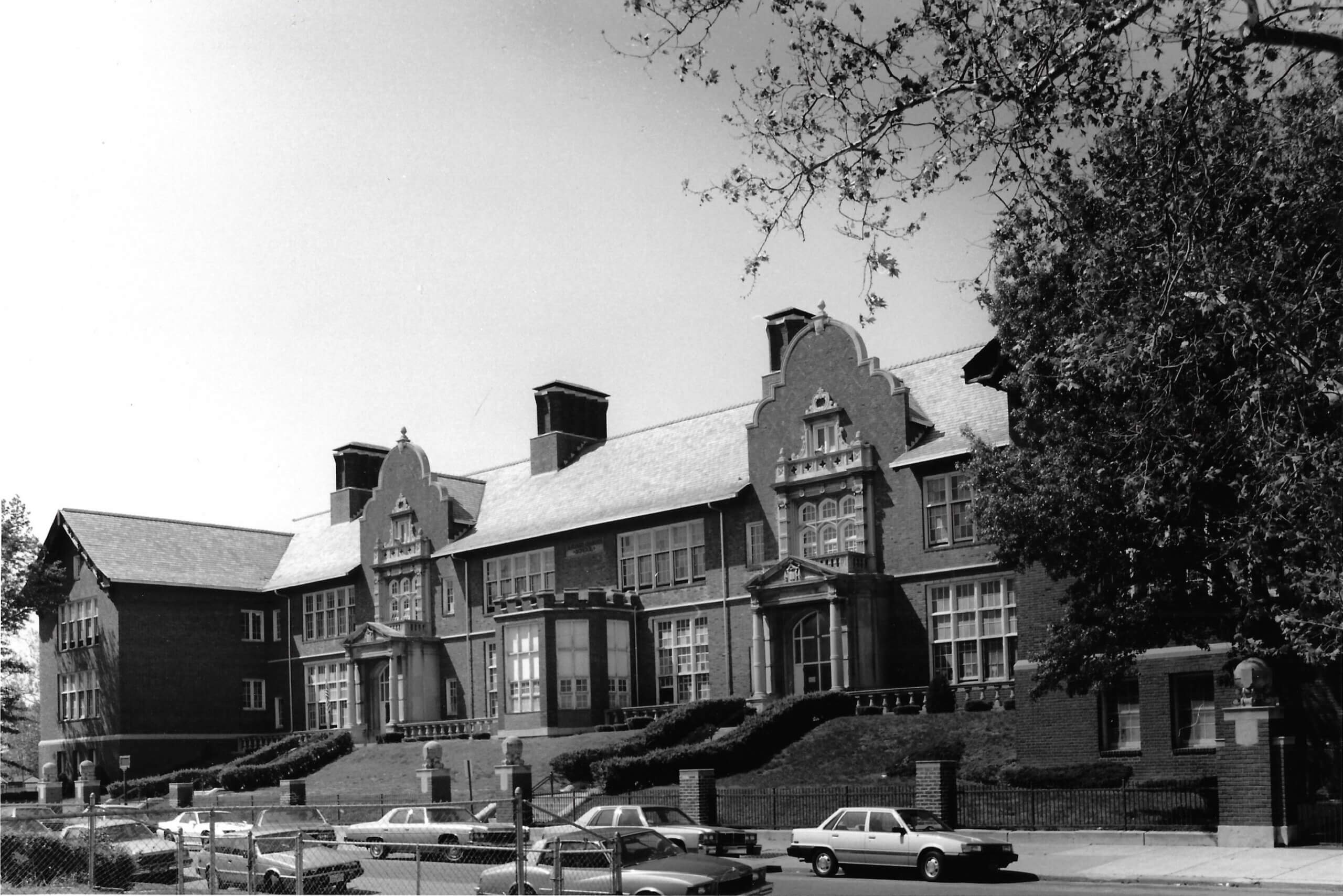
Hamilton School, 5819 Westminster Place. #33/68. Cynthia Longwisch, 1988.
Landmarks Assoc. School Architectural Survey
The slightly bruised Hamilton facade was certainly no big box like Cole School was. I’d be proud to teach here at such an edifice that was as distinguished looking to the untrained eye as Sumner and Harris Teachers College were. I went home and continued polishing off my lesson plans for SIXTH GRADE.
But when I showed up for Teacher Orientation as a skinny 21-year-old fledgling, I was unceremoniously told by the principal that I would be reporting to “ROOM ONE.” And then the school’s CEO announced just as unceremoniously that I would be teaching 8th grade!!! When I nearly fainted and stifled some reactionary coughs, the principal snapped “Take it or leave it!”
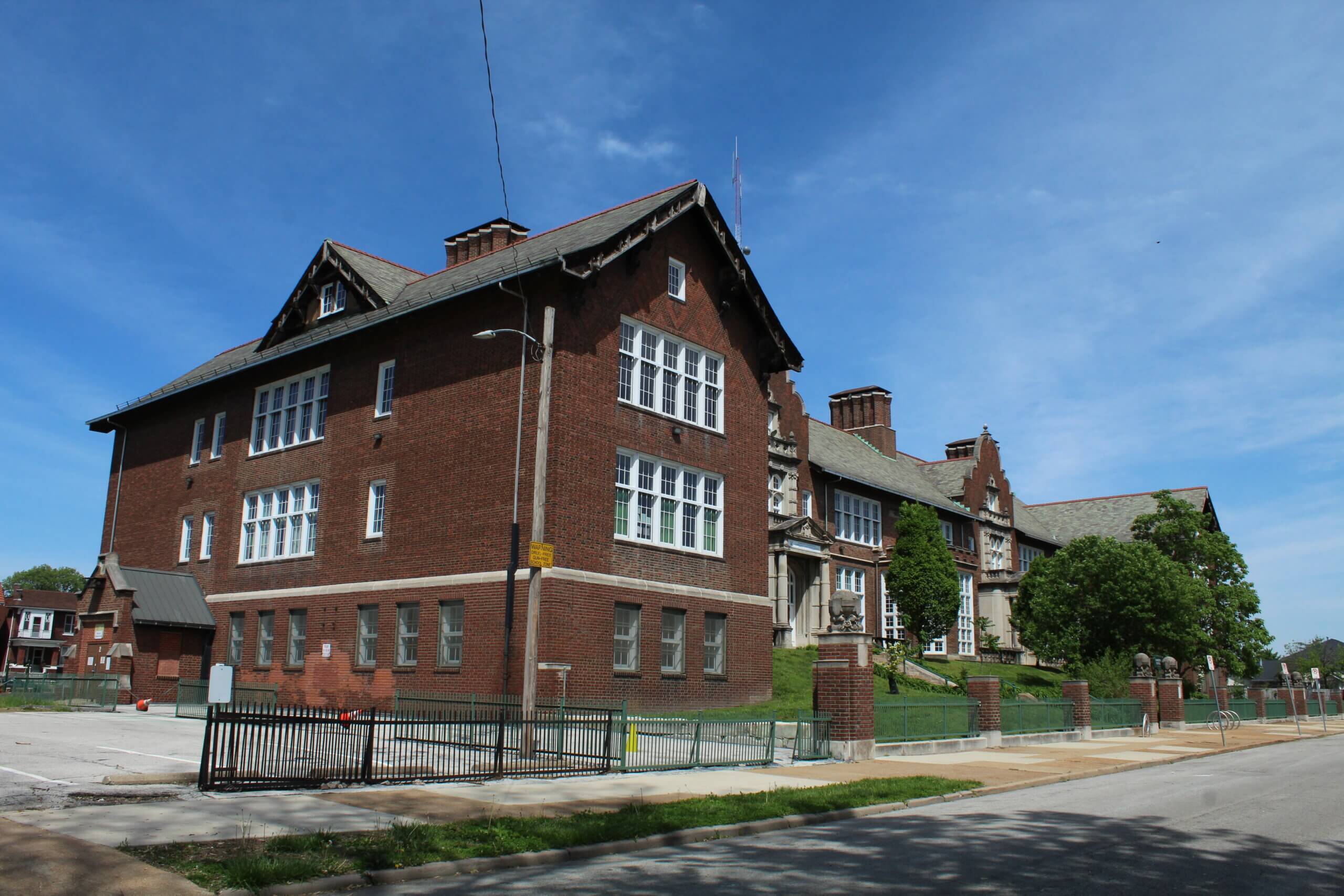
Hamilton Elementary School, 5819 Westminster Place, Chris Naffziger 2021
Exploring the new jobsite from the inside, Hamilton School’s Room 1 was sequestered in the very southwestern corner of the long second-floor hallway. Room 2 was just across the hall. Relative isolation, if desired. (I was still recovering from the shock that I would be teaching 37 young people just a very few years younger than my 21-years of age.)
But the Milligan-cum-Ittner design meant that nobody would need to pass my room to get from here-to-there. Nor there-to-here. There was no need for anybody to pass Room 1 to get anywhere else in the building. Thanks, Mr. Milligan for the long hallway plan that allowed my first class and the novice teacher to semi-cloister by day.
On the first day of classes, I had to be a non-smiling, all business, no nonsense, stick-in-the-mud. Some of my 37 students were 15 and 16 years old. Just a tad younger than I. Insurrection would have ended my career. Or my life.
In a panic, I reached back and decided to resurrect the dormant, but still percolating “Sumner Snootiness.” It would be good armor. After a week or so of trying to put names with faces I launched an Emergency Program. I took the class on an odd first Field Trip: a slow walk around the perimeter of Milligan’s building they had seen and paid virtually no attention to. “Is this new teacher nuts?”
I had them figure out what designation N/S/E/W our room was from the exterior. (Work in a lesson on “exterior” and “interior.”) After the surprise of learning that teens have no general sense of direction. With strong guidance, we came to the surprising conclusion of being in the SOUTHWEST corner of the building.
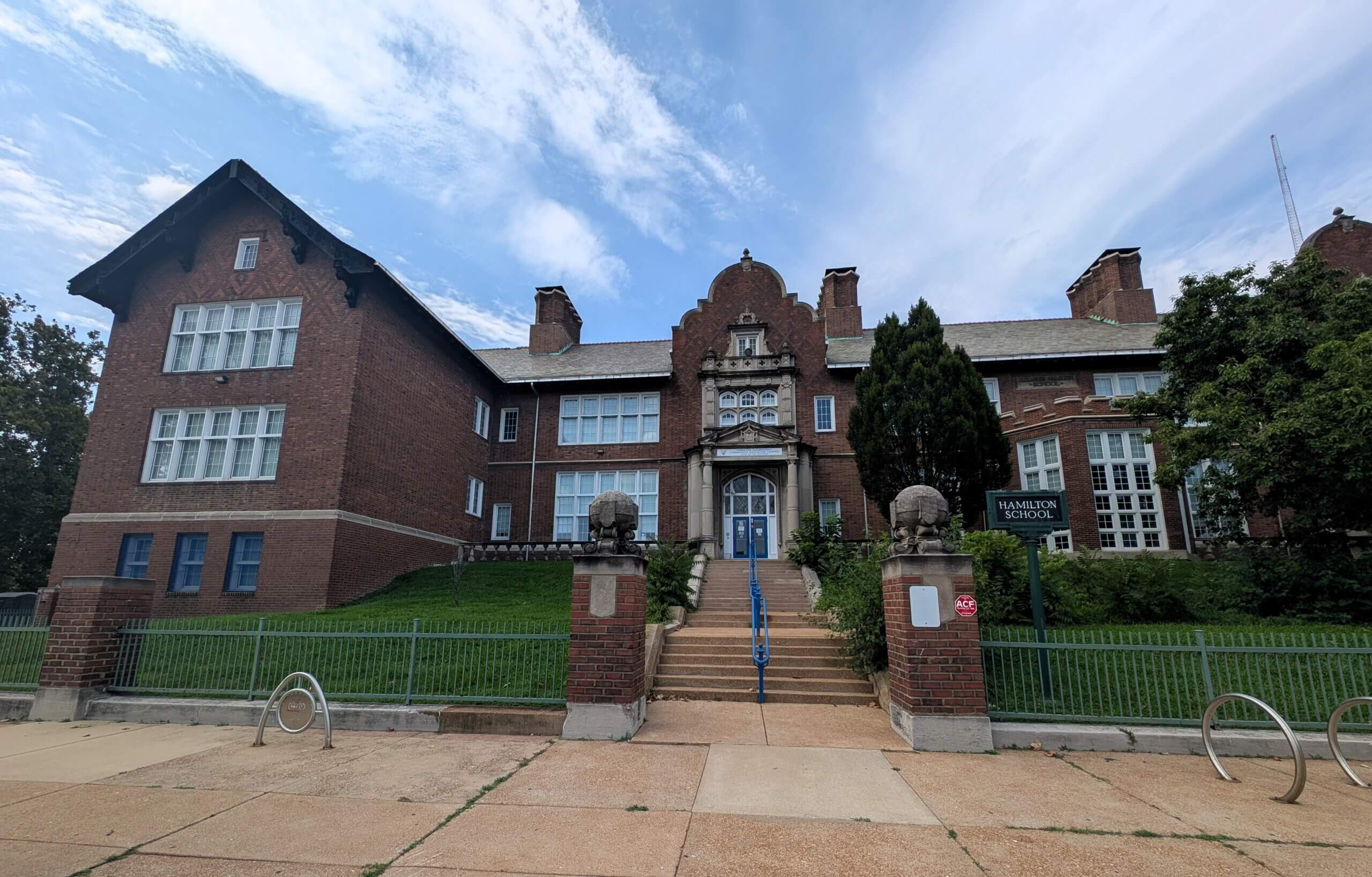
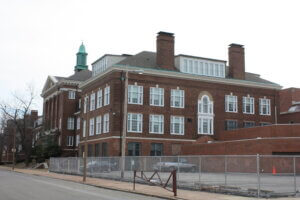
Hamilton Elementary School, 5819 Westminster Place, Katie Graebe 2026
My new students were invited to draw a picture of their school…with anything they liked being posted around the classroom corkboards.
Then within the next few weeks, the scheming neophyte teacher gently guided the Young Ladies and Young Gentlemen into insurrection. That’s how they were always addressed: “Young Ladies and Gentlemen.” NEVER “Boys and Girls.” That was “new” to them. I always referred to them by their surname title… Miss Moore, Mr. Johnson… They LOVED that. Gave them new status. Then the young people were introduced to Encyclopedia Britannica pictures of palaces and castles. Suppose our room was in a castle? We decided that! they would be attending “Hamilton Castle.” NOT Hamilton “School.” Again, they loved that. Some real artistic talent emerged. And was encouraged.
Could they really switch their desks from “rows” to two oblong concentric circles? Then we could see everybody’s face. Sure. Done. They eventually decided they were sick of looking at “Teach” all school day. So, the class was offered the option of putting Mr. Hunter’s desk at the back of the room of our castle keep. Teachers desk to the back by majority vote.
And this was their idea to cut down on tensions: Two desks, we called “Free Zones,” were put in the back of the room flanking the teacher’s desk. Any student that was sick, tired, in a really foul mood, suffering morning sickness (!!!), or just didn’t want to be bothered, could sit at either of those two desks for an hour. Just one hour a week.
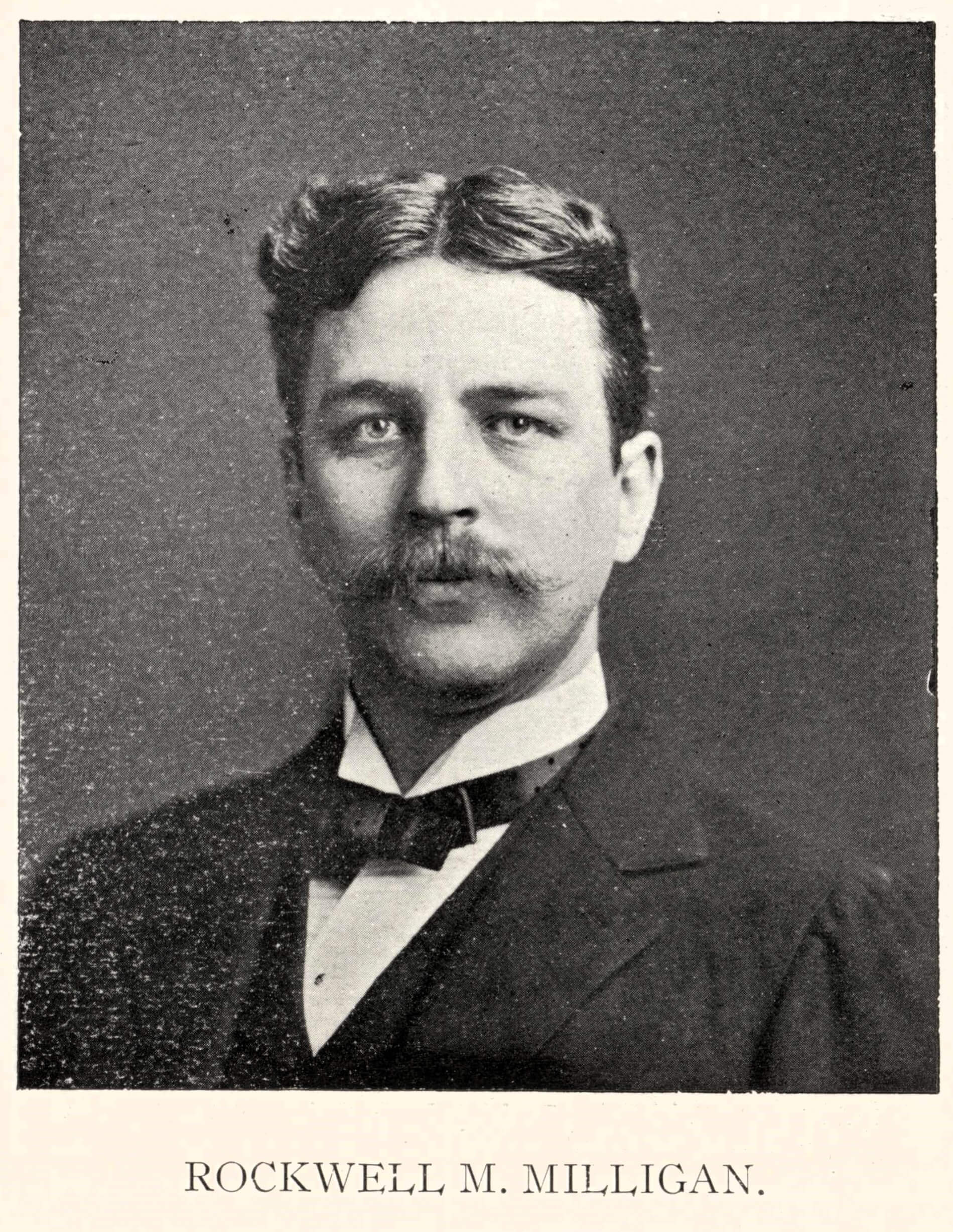
Portrait photograph of Rockwell M. Milligan (from History of St. Aldemar Commandery No. 18, Knights Templar, Volume 2, 1903). Missouri Historical Society of St. Louis
Next, the “knights and ladies” decided they were tired of their constantly being interrupted by lengthy messages on the intercom box in the back of the room. So, we/they sneakily taped a thick piece of cardboard across the scratchy speaker. And we were never bothered any more. The world did not come to an end. The teacher figured that if the end was near, we could have been notified by messenger.
The 8th Graders in whom virtually no responsibility had been invested were taking a bigtime interest in their classroom life.
How can we curb or end the constant notes from the Main Office? A cigar box on a table out our door with a big note — PUT ALL NOTES IN THIS BOX! DO NOT ENTER!!!
Revolution, without insurrection, prevailed. I’m sure that the “Young Ladies and Young Gentlemen” in Hamilton Castle did not need to know the names of Ittner and Milligan and Sanger at that point. But the 8th Graders’ school building was constructively shaping their lives.
“The 8th Graders’ school building was constructively shaping their lives.”
Then a bone of major contention developed. We decided they were too old to have their teacher come down into the schoolyard to “FETCH” them when the morning bell or the after-lunch bell clanged out!! A foot-long room number was spray-painted in white on the line-up spot. So, in a revolutionary step, the Hamilton Castle students started lining up by “twos” in the schoolyard with NO teacher present. We talked about the story of Noah’s Ark and the fact that the venerable old guy did not seem to be a cattle herder. The increasingly independent eighth graders showed everybody they could process — two-by-two in an orderly procession into and out of the building. Something reminiscent of “Sumner Snobbishness” was emerging. My students — without teacher supervision — were looking so “super cool” (in their words) that a loud crash was heard at the end of about a week of unsupervised passages in and out of Hamilton Castle. The principal — somehow enraged — summoned me to his office and informed me that I was violating school rules. Protocol called for teachers to be present when their students lined up to come into or go out of the building!
When I discussed the issue with my “young ladies and gentlemen” there were boos and hisses that had to be muffled. The remedy I proposed to my students was that the very next morning when the bell rang, I’d come down to the yard to be an escort/chaperone, but I would not say a single word to them. Not even look in their direction! I’d work on a crossword puzzle or something. And they were not to acknowledge my presence at all. What would you say to that, Messrs. Sanger? Milligan? Ittner?
When I discussed the issue with my “young ladies and gentlemen” there were boos and hisses that had to be muffled. The remedy I proposed to my students was that the very next morning when the bell rang, I’d come down to the yard to be an escort/chaperone, but I would not say a single word to them.
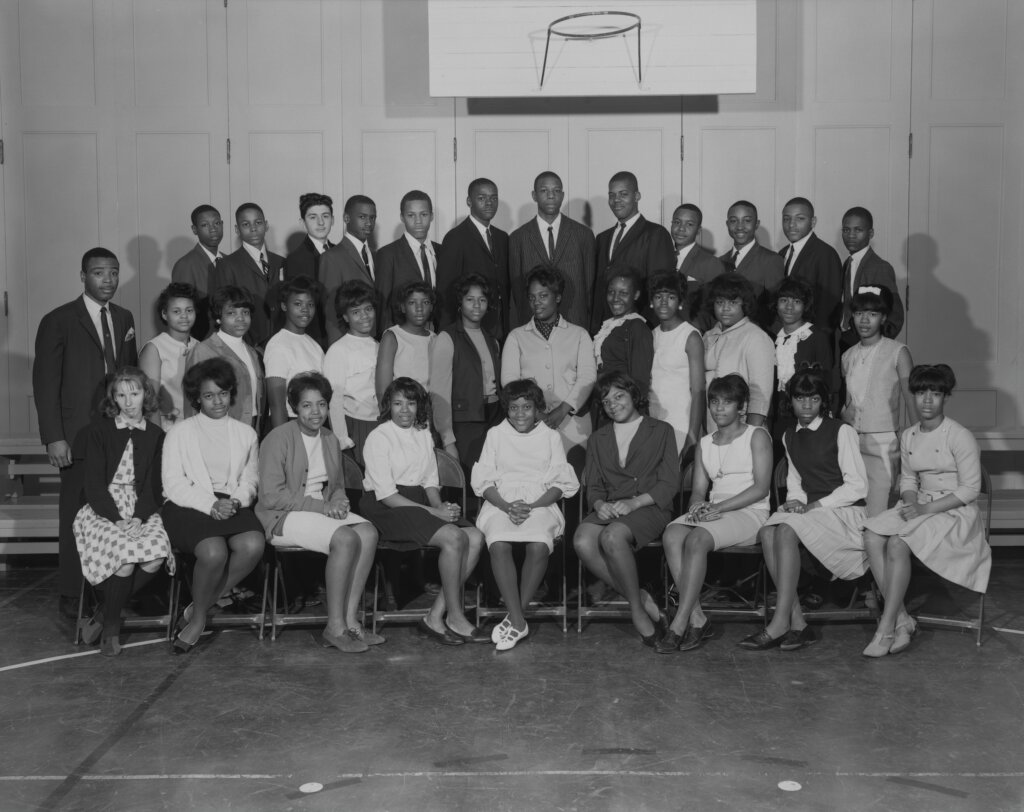
The first class Julius Hunter (far left, 2nd row) taught.
Hamilton Elementary School, 1965-66.
“There I am, 21 years old with students that were 15, 16 and a sprinkling of 17-yr-olds.”
Source: former student, Mario Alphonso Gates.
See also, Hamilton School: Graduates – June 1966 – room 1,
by unknown, 05-1966, Negative. Missouri Historical Society, P0900-43811-01-8a
Not even look in their direction! I’d work on a crossword puzzle or something.
And wouldn’t you know it? An Assistant Principal/Frat Brother told me that most complaints about the independent yard lineup came from… some of my teacher colleagues.
After several days of these independent lineups, I was summoned by the principal and told that I had an attitudinal problem. Might he have meant “Sumner Snobbishness?“
Grades were basically good. We had learned to want to be the first to help a student with 8th Grade material that was new to some students… (And new to the teacher.) We had made the “Buddy” system work. Each of us ‘fessed up when we needed time or extra studies.
Word must have spread rapidly through the School Board’s District Office about this unusually independent classroom. Soon, Hamilton Castle was being audited regularly by school officials. (Some colleagues and the principal had snidely begun referring to Room 1 as “Hunter Tower.”)
But the story of Hamilton Castle did not end when I left.
A young man we’ll call “Mario” — just 7-years younger than I– recently contacted me with a class photo of the first Hamilton Elementary School class I taught back in 1965. He had just recently retired at age 74 as a successful Construction Project Manager for a major communications company in a sprawling Southwestern U.S. City.
“Mario” fondly remembers his wonky 8th Grade teacher insisting that Room 1 had to “secede” from the rest of the school. He remembers our cloistered classes in the “castle’s” second-floor corner room. “We learned in Hunter’s classes that if we were going to make anything out of ourselves and get ahead in the world we had better start right then and there.”
“We learned in Hunter’s classes that if we were going to make anything out of ourselves and get ahead in the world we had better start right then and there.”
I’d run into another former student working proudly as a clerk at my neighborhood Post Office. Plus, a couple of class sweethearts invited me to their 25th Wedding Anniversary party 25 years after they graduated from “Hamilton Castle.”
The Lessons Continue
After a year — with all students graduating — I was transferred and “moved up” to the position of “Radio Teacher. With my KSLH radio colleagues I’d be writing 15-minute programs potentially heard by thousands of STL Public School students!
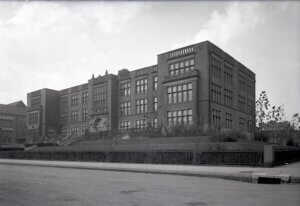
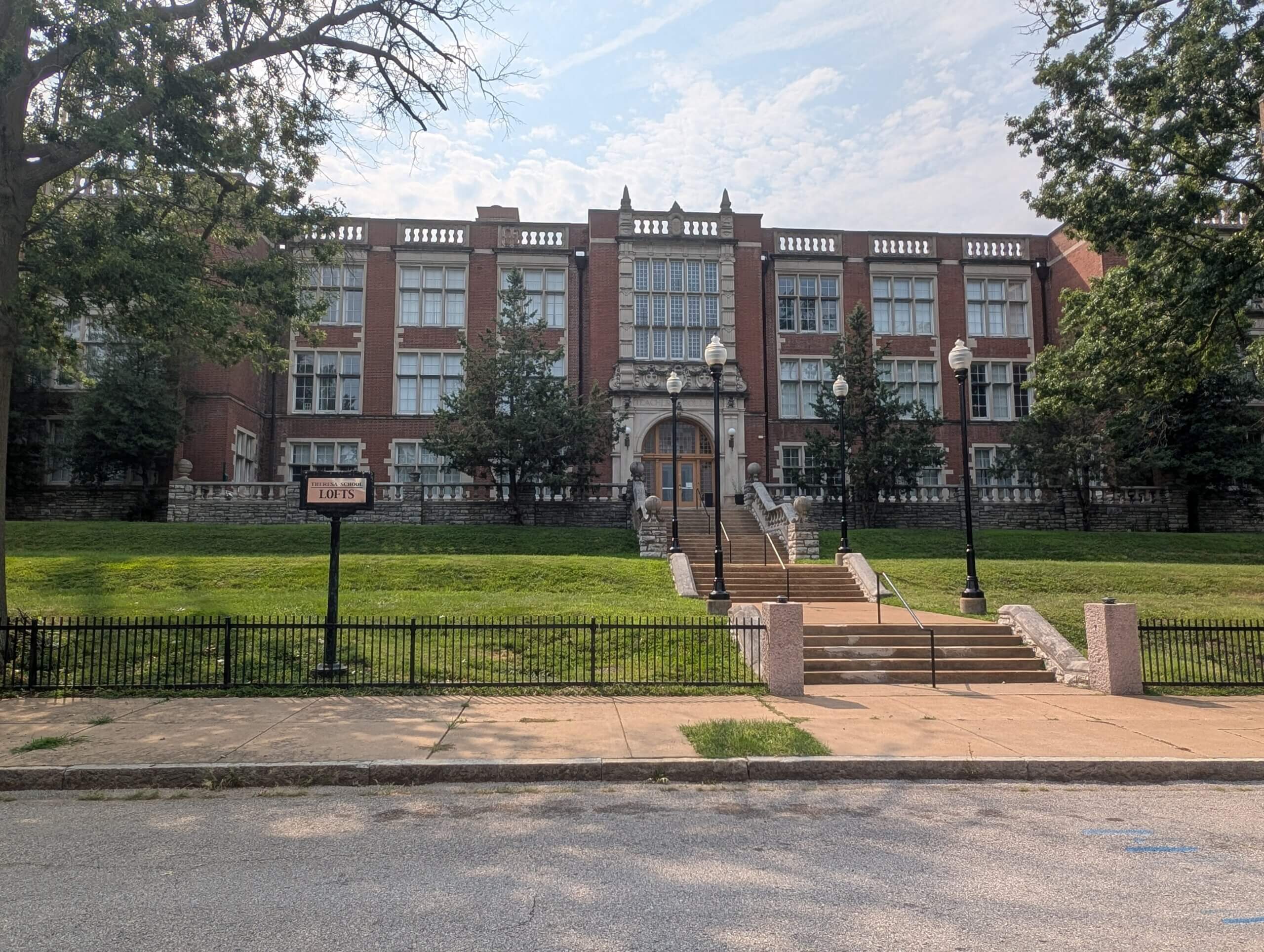
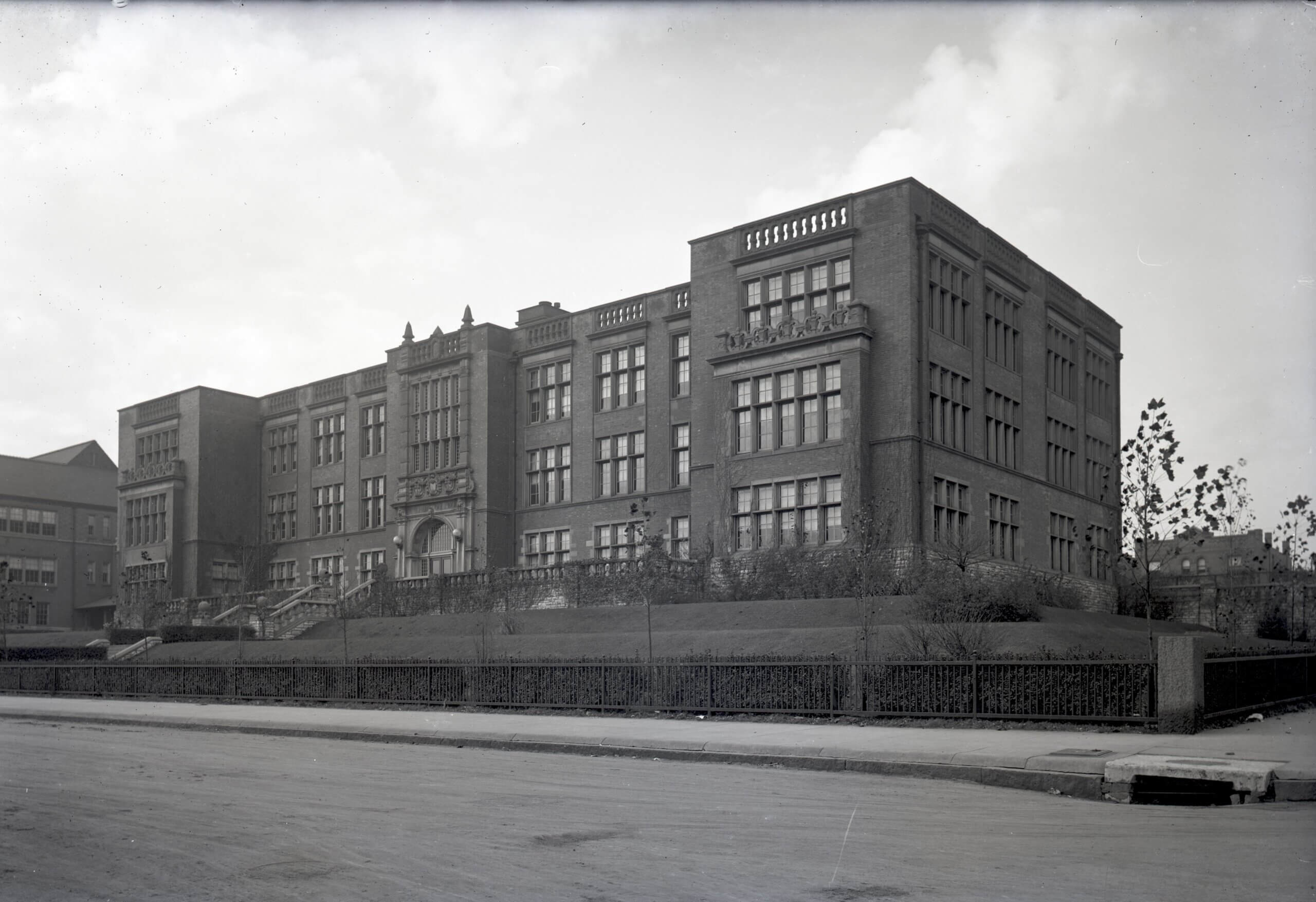
And wouldn’t you know it, Radio station KSLH was in the classic Ittner building located at 1517 S. Theresa Ave. The former 1905 HTC structure — first used to train Caucasian teachers only — has now been converted into a majestic cosmopolitan loft apartment building.
Architectural Historian Chris Naffziger noted that he thinks “Ittner wanted to make sure his ‘college’ appeared to be loftier than his dozens of grade schools and high school creations. The central corridor at HTC”, Naffziger notes, “is made of cut stone rather than terracotta. The building is sort of a mix of Tudor and Classical Baroque Revival elements.”
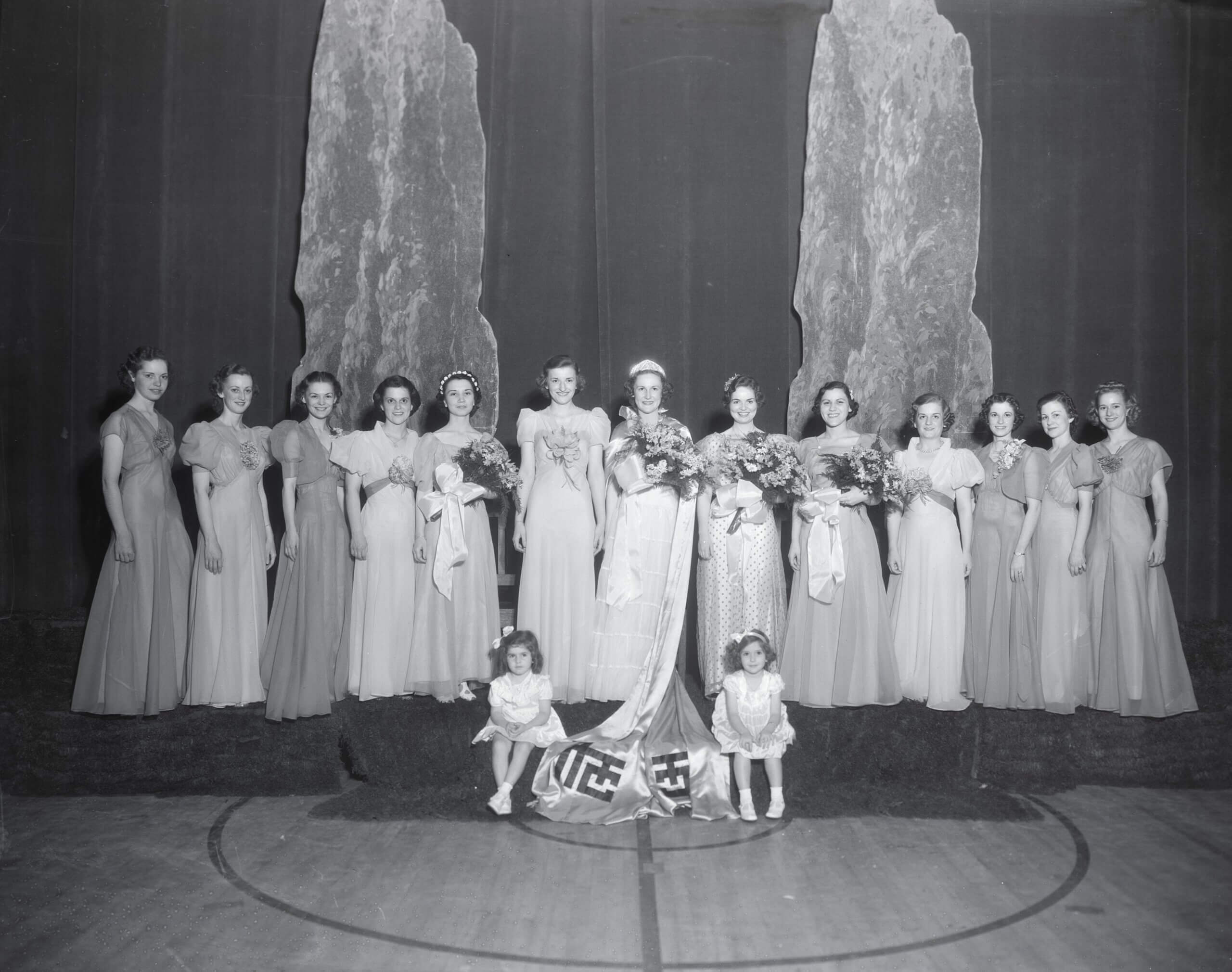
Harris Teachers College: May Festival at Roosevelt High, by unknown, 05-1937, Negative.
Missouri Historical Society of St. Louis, P0900-18018-01-8n.
Here’s to Sanger! And to Milligan! And to their innovative teacher, Ittner! And here’s to all who shape buildings in any way so those buildings can shape all of us.
Julius K. Hunter
For Landmarks Association of St. Louis
7/6/2026
~ The Author wishes to extend heartiest of thanks to the Missouri Historical Society Staff and to Architectural Historian Chris Naffziger for immeasurable assistance.

Footnotes
- Part I was featured in the August 2026 issue of the Landmarks Letter (Vol. 56, No. 1) ↩︎
- Sanger followed Rockwell M. Milligan as the St. Louis School Board’s official czar of school building design, but he copied mostly the less elaborate elements from his two immediate predecessors, Milligan and Ittner. Sanger had more memorable interior plot designs than those you’d recognize out front. ↩︎
- The twister left a reported 76 people dead — including five students at Central High School, then located in the 4000 block of McPherson. ↩︎
- Ittner is the undisputed Granddaddy of all St. Louis Public School architects. More than 50 St. Louis school buildings rose from his drawing board. ↩︎
- Today the $1,800,000 would be worth $65,338,000 to construct. ↩︎
- Vashon High School was designed by Rockwell M. Milligan in 1925. It is located at 3026 Laclede Ave. ↩︎