By Stuart Keating, Executive Director
What is Heritage/St. Louis?
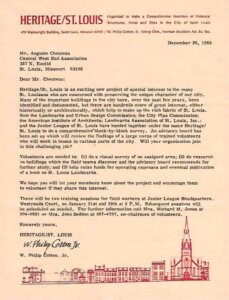
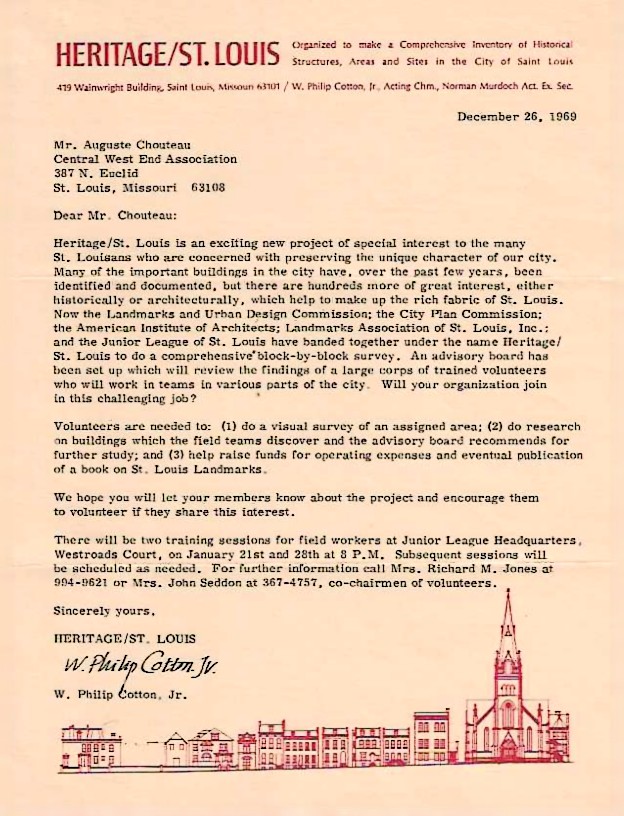
“Unless a structure is known to exist, no case can be made for saving it.” This is the rationale behind the creation of Heritage/St. Louis (hereafter referred to as Heritage STL), a partnership between the Landmarks Association of Saint Louis (that’s us!), the Landmarks and Urban Design Commission of Saint Louis, the City Plan Commission, and the St. Louis chapter of the American Institute of Architects to survey all structures within the city of Saint Louis. The coalition was announced in 1969, and soon volunteers began surveying the city, block by block.
Volunteers, armed with a camera and a manila folder full of blank survey forms, would take a photo of each building and jot down details on the provided forms. The volunteers would later match the developed photographs to the forms, and then a committee of architects would review the files, making priority lists for structures worth preserving or in need of immediate intervention.
The Junior League eventually joined the coalition, and – according to a memorandum in our files – Heritage STL was able to fundraise $58,242 over a period of a few years from public and private sources to complete the project.
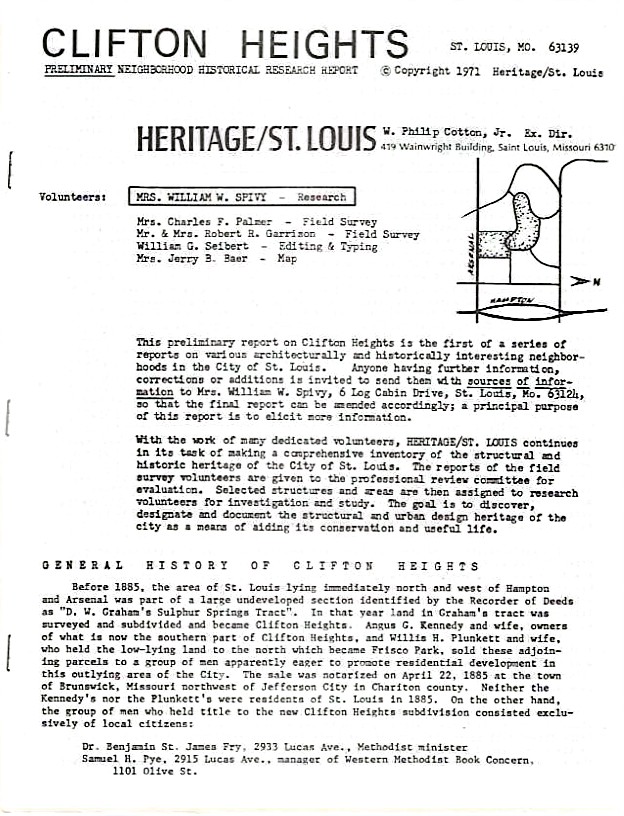
By 1971 the survey was 45% complete. Periodic updates from Landmarks Letters of the era suggest that neighborhood associations were excited about the project, with LaSalle Park requesting emergency surveys in response to proposed demolitions and Clifton Heights requesting a special report on the history of their houses. By the mid seventies, the organizers deemed the survey complete.
The original plan was for the files to go to the Saint Louis Public Library to be used for research purposes by the public. Additionally, Heritage STL planned to publish a 500-page book containing 1000 illustrations to coincide with the nation’s bicentennial in 1976. From what I can tell, no book was published, which makes sense given that the anticipated cost of publication was $100,000 – no small amount of money at the time.
Why is Heritage/St. Louis important?
To quote the Chairman of Heritage STL, architect W. Phillip Cotton, Jr., “the survey could provide information useful to the Landmarks Commission in choosing official landmarks. But its actual purpose is simply to help St. Louisans to recognize whatever in the city is of historical or architectural importance, wherever it is. This is more than an effort to keep ahead of the headache ball and the bulldozer. We want to locate the buildings and neighborhoods of earlier times that deserve special consideration and, in this way, to become better acquainted with our city’s heritage.”
Heritage STL provided the basic information for many historic register nominations and historic district creations, saving buildings from demolition and enabling the rehabilitation of hundreds of buildings through the use of historic tax credits and other financial incentives. The creation of historic districts, a time and labor-intensive process, is key to preserving the historic nature and unique characteristics of neighborhoods like Shaw, Soulard, Skinker-DeBaliviere, Compton Heights, and LaFayette Square, which all contribute to Saint Louis’ unique sense of place.
We think Heritage STL has even more to offer – a photographic survey of Saint Louis from the early 1970s provides a wealth of information about how people lived half a century ago, and a guide to what was once located on empty lots across the city.
What’s next for Heritage/St. Louis?
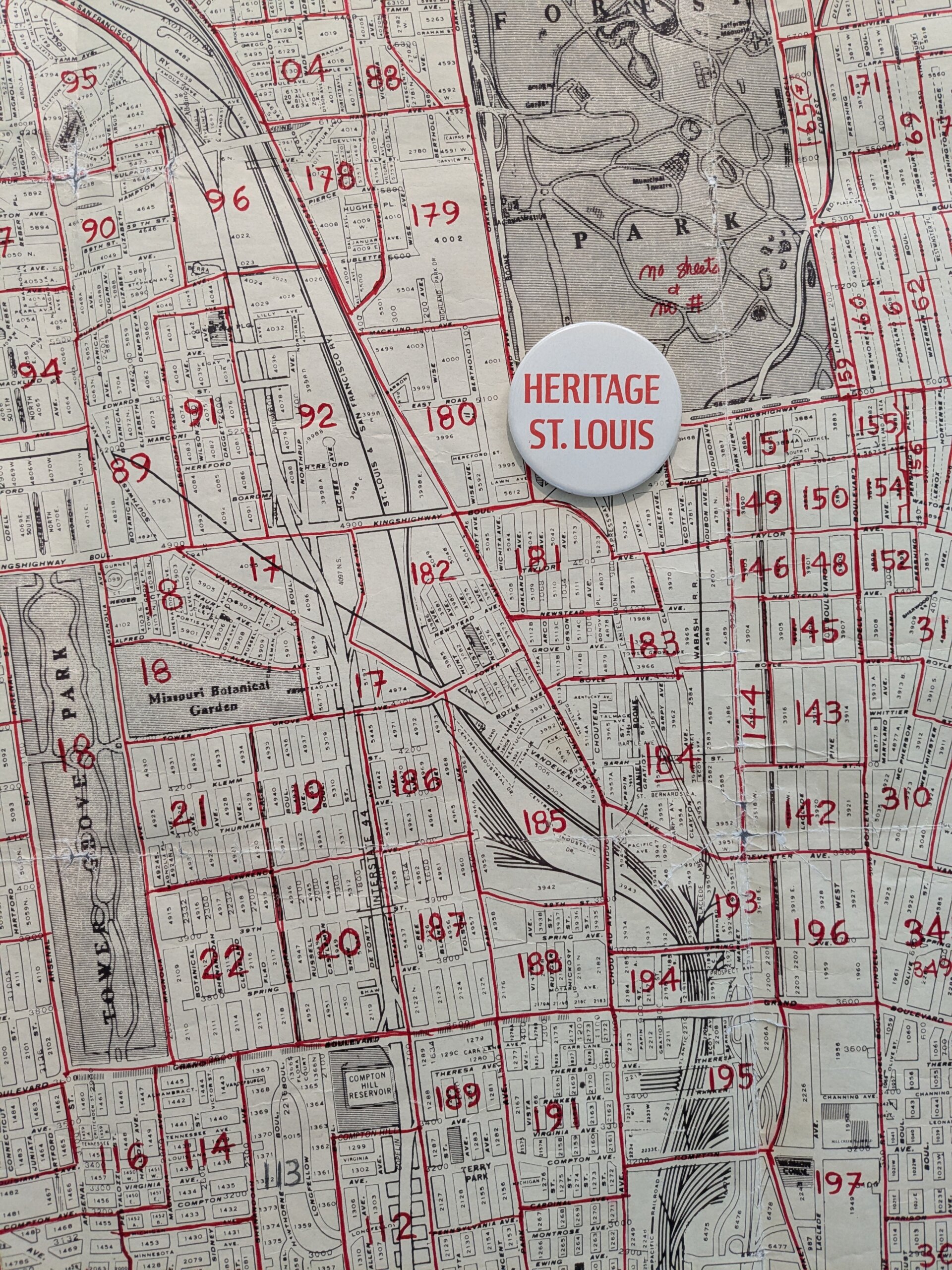
Currently, Heritage STL is in the Brambila Architectural Library: 13 boxes containing 419 file folders with an estimated 20,000-30,000 individual files. There is also a box containing photographs, a box containing negatives, a box containing updates, internal reports and miscellaneous documents, and a large map of the city that matches each file folder to a survey district.
We plan to partner with the Missouri State Archives to digitize the Heritage STL files and develop an online searchable database that we can share with the Missouri Historical Society and the Saint Louis Public Library. We hope to start the digitization project this summer.
Interview with Bill Seibert
We asked longtime Landmarks board member Bill Seibert, who volunteered for Heritage/St. Louis, some questions about his experiences as a surveyor and nominator for the National Register of Historic Places.
LA: Give us some background on Heritage/Saint Louis.
Bill: It was started in 1968 or 1969; Phillip Cotton was in charge of it. There was a group of architects from the American Institute of Architects (AIA) Historic Buildings Committee, which included Buford Pickens, Gearhart Kramer, and several others. There were six or eight of them. They recruited a whole bunch of volunteers from The Junior League and members of Landmarks – it was a big group. It was a fantastic initiative, a great collaboration between Landmarks, AIA, and Junior League.
LA: How did you get involved?
Bill: I grew up in St Louis. I started volunteering with Heritage Saint Louis in ‘69 before I got drafted. I served in the Army from 1969 to 1972, and had an exchange scholarship in the UK that they held for me. When I got out of the army in 1972 as part of Nixon’s reduction in troops after his visit to China, I went straight back to the UK to finish my studies, then came back to Saint Louis and continued volunteering for Heritage/Saint Louis.
LA: What was your involvement with Heritage/Saint Louis?
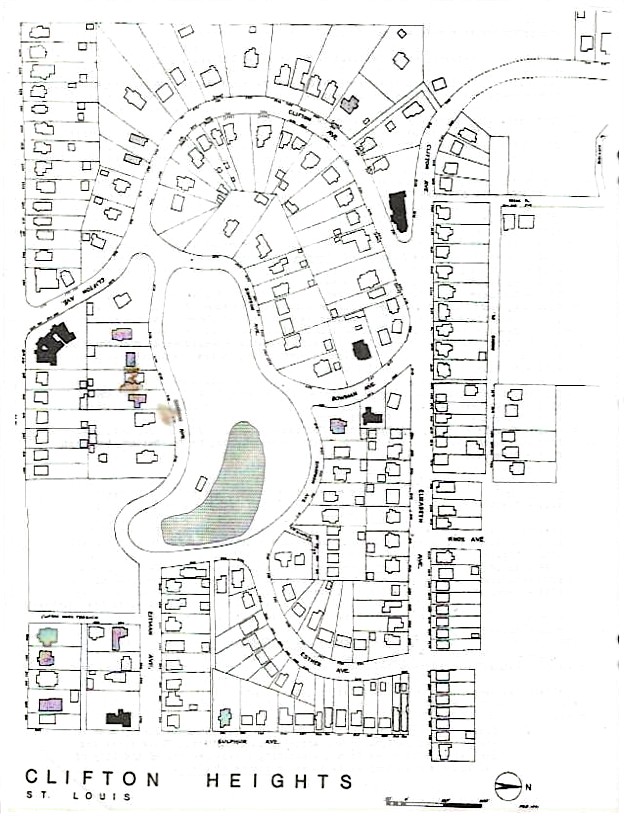
Bill: The first district I did was Chippewa from Jefferson to Grand. I remember being blown away by the corner buildings with commercial first floors and apartments on the upper floors. At that time, the petroleum industry was trying to demolish them to put gas stations everywhere, but fortunately, we still have a lot of corner buildings left in that area. I also did a group of buildings in Clifton Heights by the lake and the park. Then I ended up doing nominations for the National Register for Historic Places as part of Heritage/Saint Louis.
LA: What was it like to work on the survey?
Bill: It was a lot of walking. You’d park your car and then walk as many city blocks as you could. You had a camera and a manila envelope with blank survey forms. You’d fill one out for each building in your district. You’d fill out the form, take a photo of each building; it was up to you to get photos developed and match them to the buildings.
LA: What happened after you filled all these forms out?
Bill: We had a secretary named Betty Haynes who would take the forms and keep them organized. She’d get them to the AIA architects who would take notes, survey, and grade each building.
LA: How long did it take to complete a volunteer assignment?
Bill: The assignments were big – it would usually take three or four visits to get the whole assignment documented. You could do it in a week if you weren’t busy.
LA: This was obviously a massive undertaking. How was the end result used?
Bill: The work at Heritage/Saint Louis fit into our work doing historic districts and helped us identify buildings to nominate for the national register for historic places, making sure buildings could be preserved.
Click each image for a closer look!
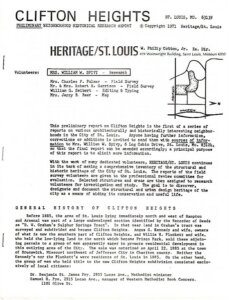
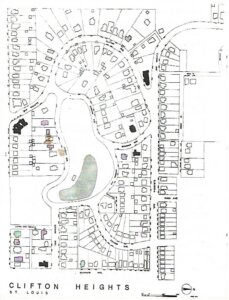
Images (from left to right):
a. Cover of Clifton Heights report, edited by Bill Seibert
b. Map of Clifton Heights report, edited by Bill Seibert
c. Letter requesting volunteers from CWE Association